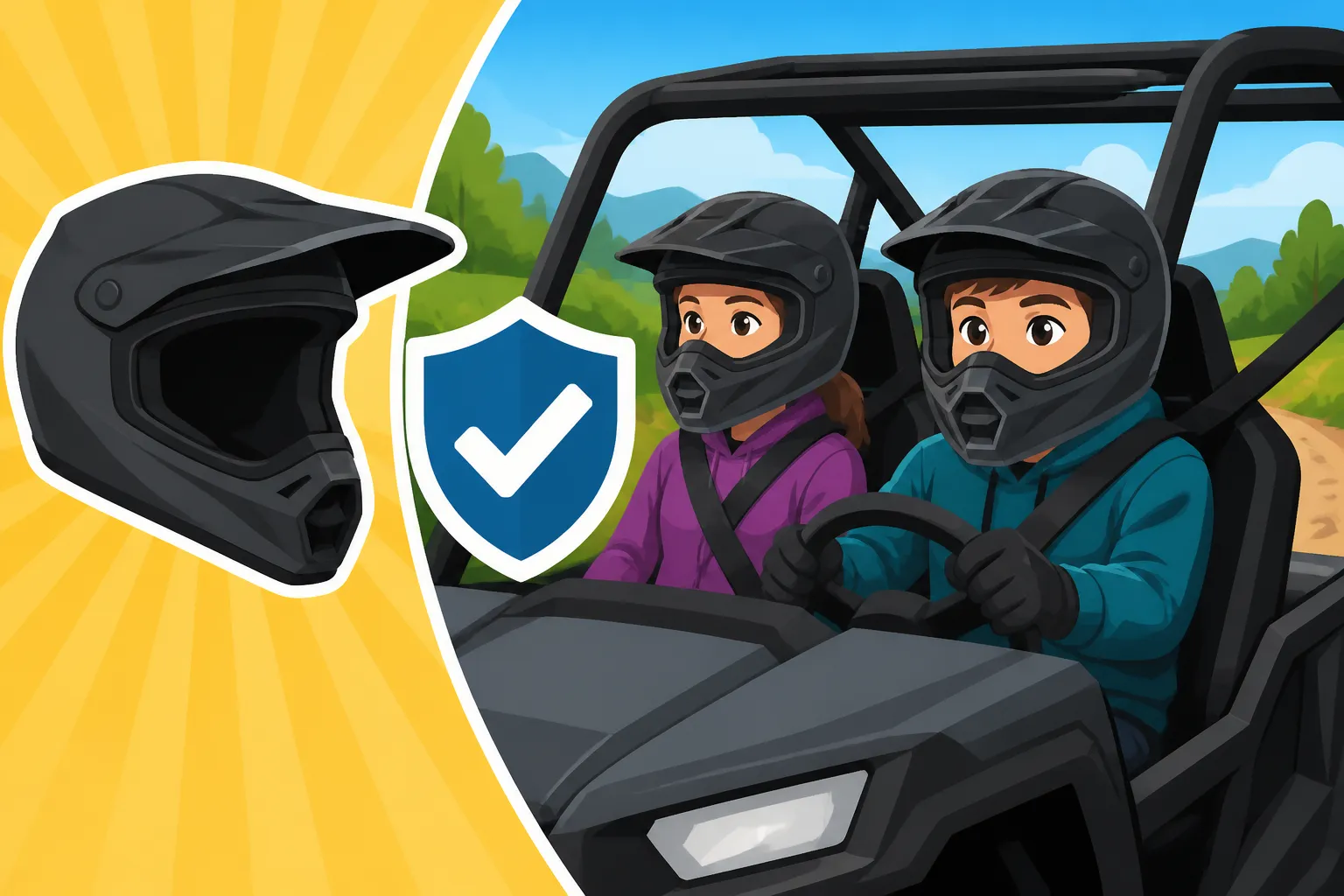
Why Under-18 Riders Wear Helmets in a UTV
Why Under-18 Riders Wear Helmets in a UTV
A UTV’s cab, roll cage, and seat belts can make it feel like a car, but they do not automatically replace a helmet for a rider under 18 in Indiana. The key questions are whether the machine has a genuinely enclosed cab, what rules apply where you ride, and whether the park has additional requirements. Here’s how to sort those out before anyone climbs in.
The helmet rule is about the rider’s age and the machine
Indiana treats a UTV as an off-road vehicle for many riding rules. For riders under 18, a helmet is generally required unless the vehicle qualifies for the enclosed-cab exception. That means a 17-year-old does not become exempt simply because an adult is driving, the UTV has a roll cage, or the trip is a short one.
A practical way to think about the rule is to separate three things:
- The rider’s age: Riders under 18 are the group the helmet requirement addresses.
- The vehicle’s design: An enclosed cab may qualify for an exception; an open or partially enclosed UTV generally should not be treated as exempt.
- The place you ride: Public trails, private riding areas, roads, and property-owner rules can each add conditions. Confirm what applies to the specific location.
The rule is not a statement that a UTV is unsafe or that its safety equipment is useless. It reflects a different kind of protection. A seat belt helps keep an occupant in the seat during a sudden stop or rollover. A helmet helps protect the head if an occupant is jolted, strikes part of the vehicle, or ends up outside the seating area. One piece of equipment does not perform the job of the other.
Indiana’s rules are only one layer of what a young rider may need to follow. A state recreation area or private park can have its own entry requirements, and some places apply their rules to every occupant regardless of age. Review the details for the destination instead of relying on what was allowed at another park. Indiana Helmet and Seat Belt Rules on Public Land explains how the two kinds of protection fit together.
The under-18 category includes riders who are 17 and younger. Turning 18 changes the age-based helmet requirement, but it does not make other safety rules disappear. A rider may still need to wear a helmet under a park’s rules, an event’s conditions, or a parent’s or owner’s requirements. An adult’s choice to ride without one does not establish what a younger passenger may do.
For families, the simplest approach is to bring a properly fitting helmet for every under-18 rider, even when you think the UTV might meet the cab exception. That avoids a last-minute dispute at the gate and gives you a safe alternative if the vehicle’s configuration or the park’s rule is not what you expected. If the park confirms that a specific enclosed-cab UTV is exempt, you can make an informed decision rather than discovering the issue after unloading.
A roll cage is not the same as an enclosed cab
This is the point that causes the most confusion. A roll cage is a protective frame around or above the occupants. It is not, by itself, an enclosed cab. A roof, windshield, doors, side panels, or nets may make a UTV feel more enclosed, but the name of an accessory does not settle whether the vehicle qualifies for an exception.
An open-sided machine with a roll cage should not be assumed to meet an enclosed-cab exception. A windshield and roof alone do not turn an open UTV into a fully enclosed vehicle. Likewise, fitting doors or panels after purchase does not automatically answer the legal question. The important issue is the actual design and configuration of the machine, together with the applicable rule.
| UTV setup | Should an under-18 rider assume a helmet is unnecessary? | Practical approach |
|---|---|---|
| Open UTV with a roll cage | No | Bring and wear a helmet |
| Roof and windshield, but open sides | No | Treat it as an open machine unless the park or relevant authority confirms otherwise |
| Doors, but substantial openings remain | No | Ask before relying on an exception |
| Enclosed-cab model with doors and enclosed occupant space | Not without checking | Confirm how the rule applies to that model and configuration |
| Enclosed-cab vehicle with doors removed or panels altered | No | Treat the changed setup cautiously and ask the destination |
The table is a planning aid, not a formal test for every make and model. Indiana’s law and the park’s interpretation control. If the machine is close to the line, ask the place where you plan to ride whether that exact UTV configuration qualifies. Provide the make, model, and details of its doors, windows, and side openings. A clear answer before the trip is more useful than arguing about a borderline setup at the gate.
Be especially cautious with removable doors, half doors, nets, and aftermarket enclosures. Owners may describe a UTV as “cabbed” because it has accessories that reduce wind or spray. That does not necessarily mean it has an enclosed cab for purposes of a helmet exception. If you cannot confidently establish that the exception applies, use a helmet.
The same caution applies when borrowing or renting a machine. A rental listing may call a model enclosed, or a friend may say that helmets are not needed in it. Those descriptions are not a substitute for confirming the rule. Ask the rental provider what protective equipment is required and whether the vehicle’s cab configuration changes the helmet requirement. For more on how rental rules can differ from the rider’s assumptions, see Indiana Rules for a Rented Machine.
A helmet should also fit and be fastened properly. A loose helmet may shift in a crash, while a helmet that does not fit the rider’s head can be uncomfortable enough that a child keeps adjusting or removing it. Choose a helmet intended for off-road riding and check for the required safety certification. A sticker or label can help identify whether a helmet meets the relevant standard; see Checking for a DOT Sticker Inside Your Helmet. A novelty helmet or costume-style head covering is not an adequate substitute.
Seat belts and helmets do different jobs
A UTV’s seat belts matter, but they do not automatically cancel a helmet requirement. When a vehicle has seat belts, occupants should use them as designed, and the riding location may require their use. A belt helps restrain the occupant within the seat and protective structure. A helmet helps protect the head. Using one does not mean the other is unnecessary.
The same distinction applies to roll cages and doors. A roll cage can help preserve space around occupants in some rollovers, and doors or nets can help keep arms and legs inside. These features can reduce some risks, but they do not guarantee that a rider’s head will never hit a surface or that the occupant will remain protected in every crash. They are not interchangeable with a helmet when the rule requires one.
For a young passenger, use a simple pre-ride check:
- Confirm that each occupant is seated in a seat designed for a passenger.
- Fasten the seat belt and adjust it so it sits correctly.
- Check that the helmet fits, is in good condition, and is fastened securely if required.
- Keep arms and legs inside the vehicle.
- Follow the UTV’s passenger limits and the park’s rules.
- Stop if a belt, door, net, or other safety equipment is damaged or cannot be secured.
Do not let a child ride in a cargo bed or in a seat not designed for an occupant. A bed may look convenient for a short trip across a staging area, but it is not a passenger seat. A passenger should also be able to reach and use the seat belt properly. If a child is too small for the belt and seat to fit as intended, the UTV may not be appropriate for that passenger.
Parents should be cautious about using an adult-sized helmet on a child simply because it is available. A helmet that is too large can move around and may not protect as intended. If the child’s head size is between helmet sizes, follow the helmet maker’s fitting instructions and choose a fit that is snug without being painful. Inspect the helmet for damage and replace it if it has been involved in a significant impact or is no longer in suitable condition.
An adult passenger or driver should not assume that a young rider’s helmet is optional because the child is inside a cab. First establish whether the specific vehicle qualifies for an exception. Then check whether the park has a stricter rule. If there is uncertainty, wearing a helmet is the straightforward choice. Indiana Helmets at Redbird and Interlake is a useful next stop if those are the riding areas you have in mind.
Check the place you are riding, not just the vehicle
A helmet decision can depend on more than the UTV itself. Indiana’s state rules, a public riding area’s operating conditions, and a private park’s own policies may all matter. A helmet exemption in one context does not automatically mean every destination will allow a young rider to go without one.
Before leaving, check the rules for the specific property and the type of riding you plan to do. Look for information about:
- Helmet requirements by age
- Whether an enclosed cab changes the rule
- Seat belt requirements
- Minimum ages or supervision conditions
- Required permits, registration, or decals
- Rules for passengers and machine capacity
- Additional requirements for special events or rentals
State recreation areas and private riding parks may not have identical rules. The park may require helmets even if a rider believes the vehicle qualifies for an exception under state law. A posted rule, permit condition, or staff direction can affect whether you may ride there. If the information online is unclear, call the park before loading the UTV.
Do not confuse a trail permit or vehicle registration with permission to ignore safety requirements. These address different matters. A registration or permit may be needed for the machine to use a particular place, but it does not replace a helmet, seat belt, age, or passenger rule. Nonresident riders should also check their obligations separately: a registration accepted for a limited period is not a blanket waiver of Indiana riding rules. Does Indiana Honor Out-of-State Registration? and Indiana’s Twenty-Day Visitor Rule cover the separate questions of registration and visitor status.
The same principle applies to private property. Having the landowner’s permission does not necessarily remove every safety obligation. A private landowner can also set stricter conditions than the minimum legal requirements. If a ride takes place on a farm, club trail, or privately operated park, ask what the owner expects and make sure the rider and vehicle are covered by those conditions. [Indiana Rules for Riding Private Property] gives more context on permission and riding on private land.
A public road introduces another set of rules. A UTV being used on a road may be subject to road-use restrictions that do not apply in the same way on a closed trail. A helmet decision is only one part of legal and safe operation. Check whether the route is open to the machine and whether the UTV meets the requirements for that particular road or crossing. Do not use a road shoulder, ditch, or short connection to a trail unless the route is permitted.
If your family is attending an organized ride, race, or guided outing, check the event instructions as well. Event organizers may require helmets for everyone or specify protective equipment for particular activities. An adult’s understanding of the general state rule may not match the event’s terms of participation.
Make the helmet decision before the trip
A short checklist can prevent confusion when it is time to load up. Start with the youngest rider and work outward: confirm age, vehicle configuration, destination rules, and the gear needed for the trip. If the vehicle’s enclosed-cab status is uncertain, plan on helmets rather than counting on an exception.
Use this order:
- Identify the machine. Confirm that it is a UTV and note whether it has a factory enclosed cab or an open cab with accessories.
- Check the rider’s age. If the rider is under 18, start from the expectation that a helmet is needed unless a clear exception applies.
- Review the destination’s rules. Check the official park or property information, and call if it does not address your exact setup.
- Prepare protective equipment. Bring a correctly fitting, approved helmet and make sure the seat belt works.
- Check permits and access separately. Confirm that the vehicle has whatever registration, permit, or authorization the location requires.
- Inspect the machine. Check belts, seats, doors or nets, tires, brakes, and lights before riding.
- Set expectations with the young rider. Explain that the helmet stays on whenever it is required, not just when an adult is watching.
If a rider refuses to wear a helmet, do not treat the ride as a chance to negotiate once the machine is moving. Make the rule clear before departure. The driver is responsible for safe operation, and a young passenger should not be pressured into a ride without equipment that is required or appropriate.
It can help to keep the helmet with the UTV rather than in a separate vehicle. Store it where it will stay clean and dry, and do not place heavy gear on top of it. Before each ride, check that the chin strap fastens and that the helmet has not been damaged during storage or transport. Carrying a helmet is not enough if it is left in the truck or cannot be worn comfortably.
For younger riders, the adult should also account for the rest of the trip: trail difficulty, weather, ride length, and whether the child can remain seated and belted for the whole route. A helmet is one part of safety, not a reason to take a passenger onto terrain or into a vehicle that is not suited to them. Make conservative choices when the route is rough, the weather is poor, or the child is tired.
The bottom line is simple: a UTV’s roll cage and seat belts do not, by themselves, make a helmet unnecessary for an under-18 rider. Confirm that an actual enclosed-cab exception applies to the machine and location, follow any stricter park rules, and use a properly fitting helmet whenever the answer is uncertain. The easiest trip is the one where the safety question has been settled before the engine starts.
Frequently Asked Questions
Does a roll cage count as an enclosed cab in Indiana?
Do not assume so. A roll cage is a frame, not necessarily an enclosed cab. If the UTV has open sides or only a roof and windshield, plan on a helmet unless the riding location confirms that the specific configuration qualifies for an exception.
Does a seat belt let an under-18 rider skip a helmet?
No. Seat belts and helmets serve different purposes. Use the seat belt when required or provided, and follow the helmet rule that applies to the rider, vehicle, and location.
Does the enclosed-cab exception apply at every Indiana riding area?
Not necessarily. The relevant state rule and the riding area’s own conditions both matter. Check with the specific park or property, especially if the UTV has removable doors or aftermarket panels.
Does an out-of-state registration exempt a young passenger from Indiana’s helmet rules?
No. Registration and helmet requirements are separate. A visiting rider should check the rules for the machine and destination, and should not treat out-of-state paperwork as a safety-rule exemption.
Disclaimer
This article is for general informational purposes only and does not constitute professional advice. Laws, prices and regulations vary by location and change over time. Consult a qualified professional for guidance on your specific situation.