Why Hoosier National Forest Has No ATV Trails
Hoosier National Forest looks like the kind of place where an ATV ride should be easy to plan: miles of woods, gravel roads, and public land. The frustrating catch is that forest land does not automatically include ATV trails. This guide explains why the forest has no designated ATV trail system, what motorized access may still be allowed, and where Indiana riders can go instead.
Why Hoosier National Forest has no ATV trails
Public forest land is not automatically open to ATVs
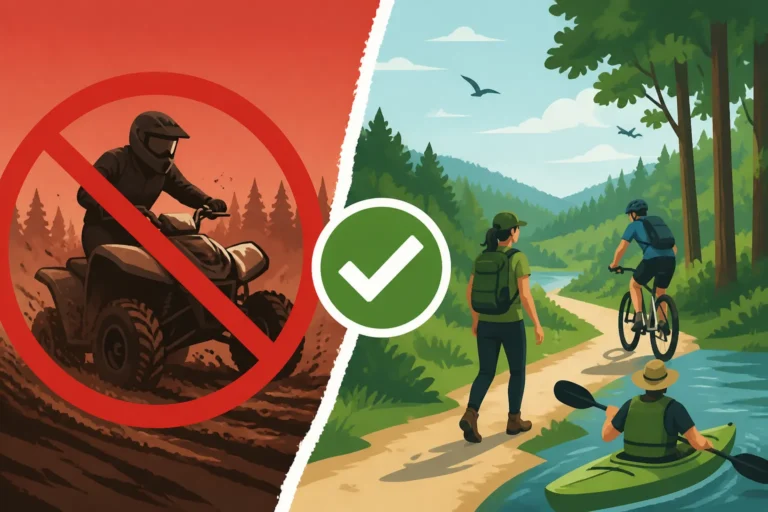
The Hoosier National Forest covers a large area of southern Indiana, but its size does not mean riders can take an ATV wherever a trail or open patch of ground appears. Motorized use is controlled by designated routes and applicable forest rules. The forest does not offer a designated ATV trail system for recreational riding.
That distinction matters because an ATV rider may see a gravel track, a logging road, or a path leading into the woods and reasonably assume it is a public riding route. It may instead be a hiking or horse trail, an administrative road, a closed route, or land managed under a different access rule. A route’s appearance—and the fact that it is on public land—does not establish that ATVs are allowed.
The forest’s approach is less about whether ATVs are enjoyable and more about managing the impacts of motorized traffic. Soil erosion, damage to vegetation, noise, conflicts with hikers and equestrians, and disturbance to wildlife can all become harder to control when vehicles spread beyond specific routes. Keeping motorized travel limited to designated roads and routes helps land managers set clearer boundaries and reduce those impacts.
For a rider, the practical result is simple but disappointing: do not treat Hoosier National Forest as an ATV park. Before using any forest road, check whether that specific road is designated for the type of motorized vehicle you plan to operate. A road that appears open on a general map may have a different status on the forest’s official motor-vehicle-use map or under a current closure.
Roads and trails have different rules
A forest road is not necessarily an ATV trail. Some roads may be designated for certain motor vehicles, while other roads or trails are closed to public motorized use. Even when a road is open to motor vehicles, the designation may not mean that every off-highway vehicle is permitted. Vehicle type, road status, seasonal restrictions, and posted orders can all matter.
This is why riders should distinguish between reaching a destination by road and riding recreationally on an ATV trail network. A permitted road route may provide access through the forest, but it does not turn nearby hiking trails or unmarked tracks into legal ATV routes. Staying on the designated route is essential; cutting onto a side trail can turn an otherwise lawful trip into unauthorized riding.
For the broader background on the forest’s motorized-use policy, see [Why Hoosier National Forest Bans ATV Riding](Why Hoosier National Forest Bans ATV Riding). The key takeaway is not that every motorized vehicle is barred from every road, but that recreational ATV trail riding is not provided as a designated use in the forest.
Maps and signs are more reliable than assumptions
Before leaving home, look for the forest’s current motor-vehicle-use map and any applicable notices or closure orders. Read the map legend carefully, including its explanation of which roads are open to which vehicle types and during what periods. If a route is not clearly designated for your ATV, do not assume that it is allowed simply because a mapping app shows a line through the woods.
Apps such as onX Offroad can help with trip planning and orientation, but a mapped route is not, by itself, proof that a vehicle is permitted there. Map layers may show roads or trails without explaining every local restriction, seasonal closure, or change in access. Use a mapping app as a navigation aid, then compare the proposed route with official forest information and signs on the ground.
If you arrive and find a gate, closure sign, or a route designation that conflicts with your plan, turn around rather than trying to find a way around it. Forest boundaries can be confusing, especially where public land meets private property or roads managed by another agency. A quick check before unloading can prevent a wasted drive, a trespass problem, or damage to a route that is closed for a reason.
What riders can do in the forest instead
Enjoy nonmotorized trails and other recreation
Hoosier National Forest still offers outdoor recreation; it simply is not a designated ATV trail destination. Depending on the location and current conditions, visitors may be able to hike, ride horses, camp, fish, or enjoy other nonmotorized activities. Those uses have their own route rules, parking arrangements, and seasonal considerations, so it is worth checking the specific recreation site before setting out.
That can still make the forest a worthwhile trip for a family or riding group with mixed interests. One person might prefer a hike, while another enjoys fishing or a quiet campground. The important thing is to plan around the activity the site actually supports rather than bringing an ATV and expecting to ride forest trails.
Motorized access and nonmotorized recreation can also overlap in the same general area without sharing the same routes. A trailhead parking lot, for example, does not imply that the hiking trail beyond it is open to ATVs. Follow signs and route markings, and keep vehicles on the routes specifically designated for them.
For a closer look at permitted alternatives, read [What Hoosier National Forest Allows Instead of ATV Trails](What Hoosier National Forest Allows Instead of ATV Trails). It helps set expectations: the forest may offer a full day outdoors, but that day may need to be planned around activities other than ATV trail riding.
Check the route before you trailer the machine
A common frustration is discovering the access rules only after driving a long distance with a trailer. Avoid that by checking the intended location before loading. Confirm the land manager, the vehicle rules, the status of the route, and whether any closure applies. If the information is unclear, contact the appropriate forest office or land manager rather than relying on a trail name found in a forum or an old map.
A practical pre-trip check looks like this:
- Identify the exact access point and route you intend to use.
- Confirm who manages that land and route.
- Check the official motor-vehicle-use map and posted restrictions.
- Look for current closure notices or seasonal limitations.
- Make sure your machine is allowed on the designated route.
- Save a legal alternative riding destination in case the forest route does not fit your plan.
Digital tools can make this process easier, especially when a group is comparing several possible routes. onX Offroad may help riders review mapped roads and plan a route, but it should be treated as a planning aid—not as permission to ride. Match what you see in the app against the official rules for the specific land you plan to visit.
If the forest does not offer the riding experience you want, that is a good time to switch destinations instead of trying to make an unsuitable route work. [Where to Ride When the National Forest Is Closed](Where to Ride When the National Forest Is Closed) covers the broader question of finding an appropriate place to ride when public forest trails are not available.
Where to ride an ATV in Indiana instead
Choose a managed riding area
Indiana has established places designed for off-road riding, which are a better fit when your goal is to spend the day on ATV trails rather than travel along a designated forest road. Redbird Off-Road State Recreation Area near Dugger and Interlake Off-Road State Recreation Area near Lynnville are two well-known options. Their rules, terrain, access, permits, and operating conditions differ, so check the details for your planned visit before heading out.
At a managed riding area, trail use is part of the purpose of the site. That does not mean every trail is open to every machine or that conditions never change. Riders still need to follow posted trail designations, park rules, closures, and permit requirements. But the basic question—whether the location is intended for off-road riding—is much clearer than it is on a general-purpose forest road.
For a first visit, consider how comfortable your group is with the terrain and what type of machine you have. A narrow trail, steep hill, deep mud section, or route shared with larger vehicles can feel very different from an easy gravel-road ride. Review the park’s trail information, choose routes suited to the least experienced rider in your group, and avoid pushing beyond your comfort level just because a trail appears open.
You can compare the two public riding areas in [Indiana's Two State ORV Areas Compared](Indiana's Two State ORV Areas Compared), then check the individual pages for [Redbird Off-Road State Recreation Area](Redbird Off-Road State Recreation Area) and [Interlake Off-Road State Recreation Area](Interlake Off-Road State Recreation Area). These are more appropriate starting points for riders looking specifically for a designated off-road experience.
Consider private parks and check the rules first
Private riding parks offer another option, but each property sets its own access conditions. Some may have different terrain or vehicle rules, and requirements can include admission, a waiver, vehicle restrictions, or specific operating hours. Do not assume that one park’s rules carry over to another.
Before visiting, check whether the park allows your vehicle type and whether its trails match your group’s experience. If you ride a side-by-side, confirm access for its size and configuration. If you are bringing children, ask about youth riding areas, supervision, and protective gear. For any park, arrive ready to follow the posted rules rather than expecting staff to make an exception at the gate.
The list of [Indiana's Private Off-Road Parks](Indiana's Private Off-Road Parks) can help you explore alternatives, while [Indiana Trail Maps From the DNR](Indiana Trail Maps From the DNR) is useful when researching state-managed riding areas. Check [Indiana Trail Closures to Check](Indiana Trail Closures to Check) before you commit to a destination, especially after heavy rain or during a seasonal closure period.
| Riding option | Best fit | What to verify before you go |
|---|---|---|
| Hoosier National Forest | Hiking, camping, and other forest recreation; limited motorized travel only where designated | Whether the exact road is open to your vehicle type, plus current closures |
| Redbird or Interlake | Riders looking for designated off-road riding areas | Permits, access rules, trail conditions, machine suitability, and hours |
| Private off-road park | Riders seeking a privately managed riding destination | Admission and waiver rules, vehicle restrictions, hours, and trail difficulty |
Make the destination match the ride you want
The easiest way to avoid disappointment is to decide what kind of day you want before choosing a location. If the priority is wooded scenery and nonmotorized recreation, Hoosier National Forest may be a good destination. If the priority is riding an ATV on designated trails, plan for an established riding area or a private park that permits your machine.
This distinction also helps when a group includes people with different expectations. One rider may be content to explore forest roads where permitted, while another expects mud, hills, and a connected trail network. Talk through that difference before loading the trailer. Choosing a site designed for ATV use is usually more satisfying—and safer—than arriving at a place where the vehicle rules do not match the plan.
For more destination ideas across the state, start with [Best Places to Ride an ATV in Indiana](Best Places to Ride an ATV in Indiana). Whichever location you choose, check its own rules on the day of your trip. Trail access can depend on land-management decisions and conditions, and a route that was available on a previous visit may not be open now.
A simple planning checklist for Hoosier National Forest trips
If you are going for forest recreation
Plan the trip around an activity the forest supports, such as hiking, camping, or fishing, and confirm the details for the particular recreation site. Check access roads, parking, site rules, and any notices that could affect your visit. If you are traveling with an ATV, do not treat the forest as a place to unload and explore unless the precise route is designated for your vehicle.
Keep in mind that boundaries and access points can be easy to misread on a phone screen. A route line may cross different kinds of land or connect with a trail that has a different use designation. Bring the relevant official map or save it for offline reference, and follow posted signs when you arrive.
If the main reason for your trip is ATV riding, use the forest as a place to enjoy other activities and schedule the riding portion somewhere designed for it. That change of plan may feel inconvenient, but it is better than spending the day searching for a trail that does not exist as a designated ATV route.
If you are trying to confirm a motorized route
Write down the route name or road number, identify the managing agency, and confirm the vehicle category the route allows. Then review the official map and current notices. If the route’s status is ambiguous, ask the land manager before riding. A general road map, a trail app, or an old online post may not show the restrictions that apply today.
Keep your plan conservative. Do not leave a designated route to explore an unmarked track, and do not ride around a closed gate. If signs or official information show that the route is not open to your ATV, use an alternate destination rather than trying to interpret the restriction in your favor.
Finally, keep your group informed. Share the destination and rules before the trip, especially if one person is navigating for several machines. When everyone understands that Hoosier National Forest is not an ATV trail park, there is less chance of confusion at the trailhead—and a better chance of choosing a ride that actually fits the day you have in mind.
Disclaimer
This article is for general informational purposes only and does not constitute professional advice. Laws, prices and regulations vary by location and change over time. Consult a qualified professional for guidance on your specific situation.