Indiana Trails With Rock
Indiana riders looking for rock obstacles can find that Indiana’s trails are not usually the long stretches of bare slickrock seen in the West. The terrain is more often a mix of reclaimed mine ground, loose stone, ruts, hills, and wooded routes. This guide explains where to look, what “rocky” riding may mean here, and how to choose a route that suits your machine and experience.
What rocky ATV trails in Indiana are really like
Expect mixed terrain, not miles of slickrock
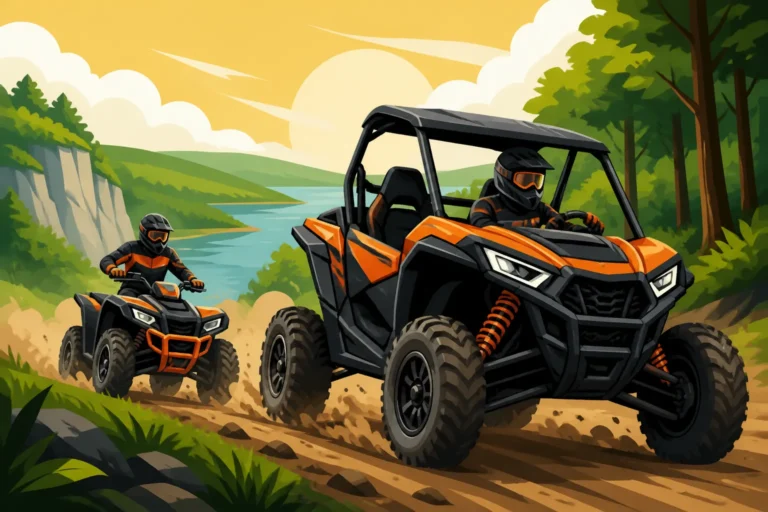
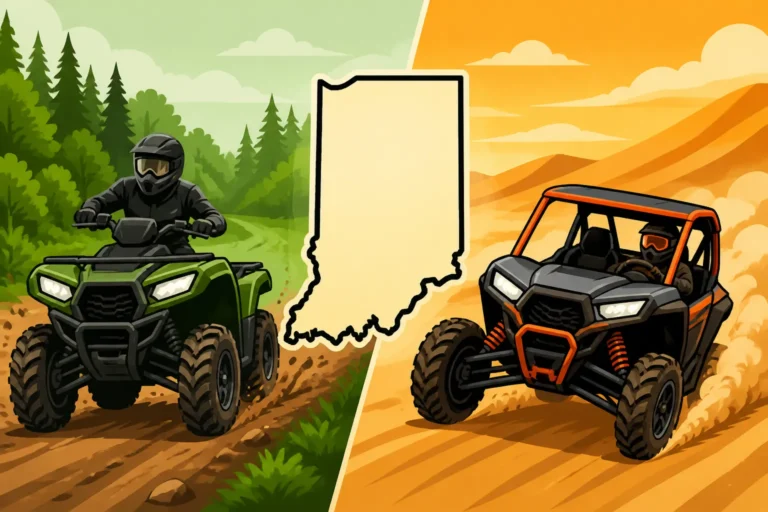
If you picture a broad, exposed rock ledge or a smooth sandstone trail, Indiana may feel different from what you have in mind. Much of the state’s off-road riding terrain is wooded or shaped by former mining and earthmoving. A route described as rocky may have scattered stones, rough climbs, embedded rock, uneven mine spoil, or a rocky stretch mixed into mud and dirt.
That variety can make a ride more challenging than the word “rocky” suggests. A short, loose-stone climb can be harder than a longer dirt trail if the surface is steep, damp, or rutted. Meanwhile, a wider machine may feel comfortable on an open mine bench but be awkward on a narrow, uneven section. The trail label alone won’t tell you how a particular obstacle will feel from the seat.
It also helps to separate natural rock from loose material left by past land use. On reclaimed ground, a rough surface may include compacted soil, gravel, broken stone, or uneven spoil. Those conditions can change with rain, traffic, and trail maintenance. For more context on how Indiana’s former mining landscape shapes riding, see [Why So Many Indiana Trails Are Old Coal Mines].
Why conditions matter as much as the trail name
The same route can ride very differently from one weekend to the next. A dry, firm climb may offer predictable traction; after rain, the dirt between stones can turn slick, and loose material may shift under the tires. In other places, a wet route can develop ruts that make rocks harder to see or avoid. That is why a trail name or an old ride report should not be treated as a guarantee of today’s conditions.
Before loading up, check the park’s current trail information and ask about closures or recent weather impacts. Official park notices and maps should guide your plan; apps such as onX Offroad can help you orient yourself and review route information, but they are best treated as a planning aid rather than a substitute for posted signs or park directions. Use [Indiana Trail Conditions Before You Ride] and [Indiana Trails Closed After Rain] as useful starting points for planning around changing surfaces.
If you are traveling to a park for one particular rocky section, call or check with the park before making that the whole purpose of the trip. A route could be closed, rerouted, or simply less rocky than expected. Being flexible makes the day easier: plan a primary route, then have a lower-intensity alternative in mind.
Indiana riding areas to consider
Redbird and Interlake
Redbird Off-Road State Recreation Area near Dugger and Interlake Off-Road State Recreation Area near Lynnville are two well-known places to begin researching when you want varied off-road terrain in Indiana. Both are associated with reclaimed mine landscapes, where riders may encounter changing elevations, rough surfaces, and a mixture of trail character. That does not mean every route is a rock trail, or that a particular obstacle will be open on your visit.
Use the park’s current trail map and posted information to understand what routes are available and which ones match your group. The official trail designation matters more than a general description from a friend or an older online post. For an overview of these locations, start with [Indiana's Two State ORV Areas Compared], then review [Redbird Off-Road State Recreation Area] and [Interlake Off-Road State Recreation Area] for park-specific planning.
If one rider in your group wants more technical terrain while another prefers an easier loop, talk through that difference before you leave the staging area. Agree on where to regroup and do not let a more confident rider pressure the rest of the group into an obstacle they do not want to attempt. A route that looks manageable from the parking lot can feel very different when approached on a machine.
Private parks and other terrain choices
Private off-road parks can offer another option, but their terrain, access rules, and available routes vary. Some may have rocky or rough sections alongside mud, wooded trails, hill climbs, or open riding areas. Do not assume that a park has a specific obstacle just because it is known for challenging riding. Ask the park what is open and suitable for your machine, and confirm its current rules before you go.
[Indiana's Private Off-Road Parks] is a useful place to compare the general options. If you are considering Haspin Acres or another private venue, check directly with the operator about route conditions, machine restrictions, hours, and what equipment or paperwork you need. Park rules can differ, and a route that is suitable for a dirt bike may not be appropriate for a wide side-by-side.
The main distinction is that “rocky” can mean very different things from park to park. One place may have loose stones on a climb; another may have rock mixed with deep ruts or wet clay. If your priority is a specific kind of riding, ask a precise question: “Are there marked routes with exposed rock or loose-stone climbs open to this machine?” That is more useful than asking whether the park is generally rocky.
| Riding area type | What you may encounter | What to check before leaving |
|---|---|---|
| Reclaimed mine terrain | Hills, uneven ground, loose stone, dirt, and changing surfaces | Current map, closures, route difficulty, and recent conditions |
| Private off-road park | A park-specific mix of trails and obstacles | Machine access, open routes, rules, and current operating details |
| Wooded trail network | Roots, rocks, ruts, and narrow sections | Width restrictions, trail designation, and conditions after rain |
| Open or less technical route | Smoother dirt or gravel with fewer obstacles | Whether the route is appropriate for your group and machine |
How to choose a rocky route for your machine and group
Match difficulty to your least-experienced rider
A group ride should be planned around the person with the least experience, not the rider who wants the biggest challenge. A steep or uneven rocky section can put a beginner in an uncomfortable position quickly, especially if they are unsure how to manage throttle, braking, or body position. If someone is new to riding, choose a route with room to stop and regroup, and let them decide whether they want to try a difficult obstacle.
Look for the park’s own difficulty descriptions and use them as a guide, not a promise that every rider will find a route easy or hard. Machine size, tires, ground clearance, riding skill, and recent weather all affect how a trail feels. [Indiana Trail Difficulty Ratings] can help you think through those factors before choosing a route.
For a first trip, it may be more enjoyable to ride a moderate loop and learn how the terrain behaves than to chase the most demanding section on the map. You can always step up the difficulty on a future visit. That is especially true when children, newer riders, or machines with limited clearance are part of the group.
Prepare for loose rock and changing traction
Before riding rough or rocky ground, check the machine’s condition. Look over the tires, brakes, steering, and underbody protection, and make sure any cargo is secured. A tire with visible damage or a loose component is a bigger concern when you are far from the staging area. Carry basic repair and recovery supplies appropriate to the machine and park rules, and know how to use them before you need them.
On loose stone, smooth control is generally more useful than sudden inputs. Avoid accelerating hard into an obstacle or braking abruptly on a slope. If a route feels beyond your ability, stop somewhere safe and choose a different line or turn around where permitted. Do not ride off the marked trail to get around an obstacle; that can damage the area and may violate park rules. Review [Indiana Trail Etiquette on Shared Ground] before riding shared routes.
A map app can support your planning, but do not rely on your phone alone for navigation. Download or save the information you need before entering areas where signal may be unreliable, keep the official map accessible, and follow signs and ranger instructions. onX Offroad can be useful for reviewing your route and keeping track of your position, while the park’s own posted information remains the authority for access and closures.
A practical plan for a rock-focused ride
Check the route, rules, and gear before you travel
Start by choosing a park, then confirm that the routes you are interested in are open to your type of machine. Check whether the park requires a permit, an entrance payment, a registration decal, or other documentation, and review any age, helmet, or passenger rules that apply. Requirements can differ between public recreation areas and private parks, so do not assume one park’s checklist applies everywhere.
Use the official map to mark a conservative route and a backup option. Tell your group where you plan to ride, decide on a meeting point, and agree that nobody will continue alone if the group gets separated. If you are visiting an unfamiliar area, a simple first loop close to the staging area can help you gauge the surface before committing to a longer ride. [Indiana Trail Maps From the DNR] is a helpful reference for finding official mapping information.
Pack for the conditions rather than for the ideal version of the day. Bring water, suitable riding gear, a charged phone, and the supplies your group would need if a machine had to be checked or recovered. If rain is in the forecast, reconsider whether a rocky route is still a good choice; damp soil can change traction and make obstacles harder to read. For rider protection and park-specific expectations, read [Indiana Helmet Rules at a State ORV Area] before heading out.
Know when to turn around
A successful ride is not measured by how many difficult obstacles you clear. If a climb is slick, a rock section is beyond your ability, or a machine is taking damage, turning around is a sensible decision. The group can choose another marked route, take a break, or call the day early rather than turning a manageable problem into a recovery situation.
Be especially cautious when visibility is limited by mud, water, dust, or vegetation. Approach unfamiliar terrain slowly enough to see what is ahead, and give other riders space. If someone is stopped on a slope or around a blind bend, do not crowd them. Keep the trail clear where possible and follow park guidance if staff are managing traffic or a closure.
For the best chance of a satisfying Indiana rock ride, plan around the whole experience: choose a suitable park, confirm what is open, match the route to the group, and stay willing to adjust. Indiana’s rough terrain may not look like western slickrock, but a mix of hills, stone, mud, and reclaimed ground can still make for a memorable day when you ride within your limits.
Disclaimer
This article is for general informational purposes only and does not constitute professional advice. Laws, prices and regulations vary by location and change over time. Consult a qualified professional for guidance on your specific situation.