A Deputy at an Indiana Roadside Stop
That moment when you see the flashing lights in your rearview mirror, and you're on your ATV or UTV, can make your heart pound. Even if you think you're following all the rules, an encounter with an Indiana deputy at a roadside stop can quickly turn confusing if you're not fully prepared. This guide is here to help you understand exactly what to expect, what documents you need, and the specific regulations that govern off-road vehicle use on Indiana roads, so you can navigate such situations with confidence.
The Initial Encounter: What a Deputy Checks Roadside
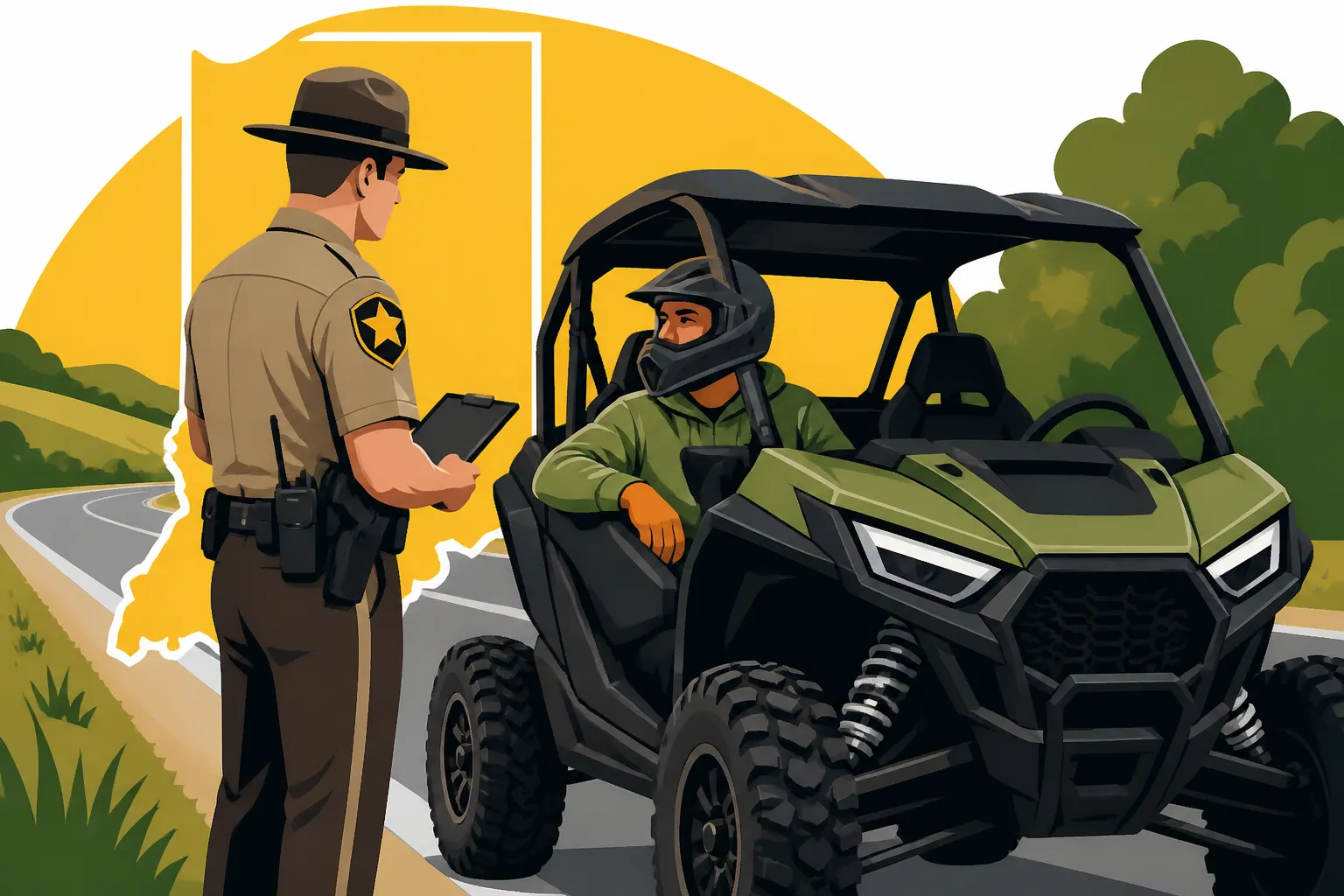
Getting pulled over while riding your ORV on an Indiana road is a scenario no one wants, but it's important to be prepared. When a deputy approaches, they're typically looking for a few key pieces of information to ensure you're operating your machine legally. It’s not just about what you’re doing in that exact moment, but whether your machine is properly documented and you’re authorized to ride it.
Decal and Registration: Your First Line of Defense
The first thing a deputy will likely look for, even before you've fully stopped, is your Indiana ORV decal. This isn't just a sticker; it's tangible proof that your machine is registered with the state. The decal should be prominently displayed on the "forward half of the machine," typically on the left side of the frame or fork. It has specific numbers and a year that indicate its validity. If it's missing, expired, or improperly placed, that's often the immediate reason for the stop. Make sure it's clean, legible, and hasn't been peeled off by mud or trail debris. You can find more details on [Indiana's ORV Decal Explained] and [Where the Indiana Decal Mounts].
Beyond the decal, the deputy will ask for your registration certificate. This small piece of paper is just as important as the decal itself, as it contains all the specifics about your ORV and its owner. While some riders might snap a picture on their phone, it's always best practice to have the physical document with you. A small, waterproof container attached to your machine or carried in a pocket is a great way to keep it safe from the elements. This document proves that the decal belongs to your machine and that you are the registered owner, or have permission from the owner to operate it.
Having your decal correctly displayed and the registration certificate handy can make the entire interaction much smoother. It shows you've taken the necessary steps to comply with state law. Without these, even if everything else is in order, you're likely facing a citation for operating an unregistered ORV, which can quickly escalate into a frustrating and costly situation.
Proof of Ownership and Identification
After verifying your registration, the deputy will want to confirm ownership of the ORV and your identity as the operator. This usually means presenting a valid driver's license or state identification card. Even if you're riding on private land and don't need a license, operating on public roads, even those designated for ORV use, usually implies a need for proper identification. If you're a minor, be prepared to show some form of ID and explain who is supervising you, as Indiana has strict rules for young riders.
For proof of ownership, this usually comes in the form of a title, especially for machines bought after 2009. Indiana requires most ORVs purchased in 2010 or later to be titled. If your machine is older than that, a bill of sale might suffice as proof of ownership, but it's crucial to understand the nuances. For more on this, check out [Titling an ORV in Indiana] and [An Indiana Bill of Sale for an ORV]. The deputy will cross-reference the VIN (Vehicle Identification Number) on your machine with the VIN on your title or bill of sale to ensure they match. Any discrepancy can lead to a more in-depth investigation, potentially impounding your machine if theft is suspected.
Having these documents readily available demonstrates legitimate ownership and helps avoid suspicion. Think of it like driving your car; you wouldn't leave home without your driver's license, registration, and proof of insurance, would you? The same level of preparedness should apply when you take your ORV onto any public thoroughfare in Indiana, even if it's just to cross a road or ride a designated shoulder.
Insurance and Operator Requirements
While Indiana does not generally mandate liability insurance for ORVs statewide, some counties that have opened their roads to ORVs do require proof of insurance. This is a critical distinction that many riders overlook. For example, Vanderburgh County, which has specific ordinances allowing ORVs on certain roads, explicitly states that operators must carry proof of financial responsibility. If you're riding in such a county, a deputy will absolutely be asking for an insurance certificate. Even if your county doesn't require it for road use, having insurance is always a smart move for your own protection and peace of mind. Learning about [Indiana ORV Insurance Requirement] is a good first step.
Beyond insurance, the deputy will verify if you are legally allowed to operate the specific machine you're on, especially concerning age restrictions. While anyone 16 or older with a valid driver's license can generally operate an ORV on roads where permitted, riders under 18 might have additional rules, such as helmet requirements (which we'll cover next) or needing direct supervision. For children under 14, operating an ORV on public land or roads is generally prohibited, even with adult supervision, though exceptions exist for training courses or very specific situations. Understanding [Indiana Driver's License Rules for ORVs] will provide more clarity on who can ride what and where. Ensure that if a minor is operating, they meet all age and supervision requirements for that specific location, as violations can lead to fines for both the minor and the supervising adult.
Understanding Indiana's Road Riding Rules
One of the biggest areas of confusion for ORV owners in Indiana is undoubtedly where they can and cannot ride their machines. It's not as simple as "yes" or "no" across the board. Indiana law has specific default rules, with critical exceptions and local variances that are absolutely essential to understand before you ever put a tire on pavement.
Why Roads Are Closed by Default (and the Exceptions)
In Indiana, the default rule is quite clear: ORVs are generally not allowed on public roads, streets, or highways. This includes the main thoroughfares, state routes, and even most county roads. The rationale behind this is safety; ORVs are designed for off-road conditions and often lack the same safety features, lighting, and signaling capabilities as street-legal vehicles. Trying to blend a utility vehicle or a sport quad into highway traffic is a recipe for disaster, and the law reflects that concern. This fundamental principle is elaborated in [Why Indiana Roads Are Closed by Default].
However, there are two primary exceptions to this blanket prohibition. The first is the "shoulder and ditch" rule. You may operate an ORV on the far right of the paved portion of a highway, road, or street, or on a shoulder or ditch. This isn't a free pass to cruise down the road, though. This operation is allowed only if the highway, road, or street has a sufficient width to provide a safe operating area for the ORV away from moving traffic, and only if it's not a limited-access highway like an interstate or major parkway. You also can't just ride for leisure; this exception is generally for specific purposes like accessing private property or making a short trip to another trail segment. For more detail, refer to [The Shoulder and Ditch Exception in Indiana].
The second, and perhaps more significant, exception comes from local ordinances. Indiana law allows counties and cities to designate specific roads or segments of roads for ORV use. This means that while state law generally says "no," your local county commissioners or city council might say "yes" to certain routes. These designated roads are typically low-traffic county roads, often unpaved, and come with their own set of local rules about speed limits, times of day, and required safety equipment. It's absolutely crucial to check the specific ordinances for any county you plan to ride in. Many riders assume that if one county has open roads, all do, and that simply isn't the case. To find out which counties allow ORVs on roads, and how to research their specific rules, look into [Indiana Counties That Allow ORVs on Roads] and [How to Find an Indiana County ORV Ordinance].
Navigating Crossings and Right-of-Ways
Even when operating legally on a shoulder, ditch, or designated county road, there will be times when you need to cross a paved public highway. Indiana law has very specific rules for these crossings, and failing to adhere to them can lead to serious fines or, worse, an accident. The core principle is safety and yielding to all other traffic. A crossing is not a right-of-way; it's a momentary necessary interruption of the flow of traffic.
First and foremost, before attempting to cross any highway, you must bring your ORV to a complete stop. This isn't a rolling stop; it's a full halt, much like at a stop sign or railroad crossing. This ensures you have ample time to observe traffic in both directions. Next, you must cross the highway at a right angle to the flow of traffic. This means aiming straight across, not at a diagonal, which minimizes the time you are in the traffic lanes and makes your intentions clearer to other drivers. This specific requirement is explained in [Crossing at Right Angles in Indiana]. You cannot weave or drive parallel to traffic for any distance on the main lanes.
Finally, and perhaps most critically, you must yield the right-of-way to all vehicular traffic on the highway. This means if there's any oncoming vehicle, you wait. You only proceed when it is completely safe to do so, without impeding any other traffic. These rules apply whether you're crossing a small county road or a busier state highway (provided the highway isn't a limited-access one, which ORVs can never cross). For a deeper dive into the overall regulations, check [Crossing a Road on an ORV in Indiana]. Disregarding these crossing rules isn't just a ticketable offense; it's extremely dangerous, putting you and others at severe risk.
Local Ordinances and Their Demands
As mentioned, individual counties in Indiana have the authority to open certain roads to ORV traffic through local ordinances. However, this power comes with specific limitations and, often, additional demands on riders. It's not a free-for-all; rather, it's a carefully regulated privilege. For example, some ordinances might restrict ORV use to specific hours of the day, or ban it entirely during certain seasons. Some counties may designate specific days for ORV use, or even require an additional local permit on top of state registration.
Vanderburgh County, for instance, has a rather comprehensive ordinance. Beyond requiring insurance, it mandates that operators be at least 18 years old to ride on county roads, and machines must have two headlights and two taillights after dark—a detail that many stock ORVs, designed for daytime trail use, might not meet. You may need to invest in some aftermarket lighting, perhaps from a reputable brand like SuperATV, to ensure compliance. Knowing about these specific demands is crucial, as a deputy in Vanderburgh County will be checking for them. This level of detail highlights why simply having a state decal isn't enough; you need to know the specific local rules of where you're riding.
These local rules can also impose fines unique to that jurisdiction, and sometimes they can be quite steep. While the state defines a Class C ORV infraction, counties might have their own penalty schedule. Therefore, before you load up your machine and head to a new county with the intention of riding its roads, take the time to research its specific ordinance. A quick search on the county's website, or a call to their highway department, can save you a lot of headache and potential legal trouble. The rules laid out in [What a Local ORV Ordinance Is Not Allowed to Require] can help you understand the boundaries of what a county can demand.
Avoiding Infractions: Helmet Laws and Prohibited Areas
Beyond registration and road rules, there are specific safety requirements and outright prohibitions that ORV riders in Indiana must heed to avoid fines and ensure their safety. These rules are in place for a reason, even if they sometimes feel inconvenient.
Indiana's Helmet Law: Who, Where, and When
Indiana has a clear and straightforward helmet law for ORV operators and passengers, though it sometimes causes confusion. The rule states that any person under 18 years of age who is operating or riding on an ORV must wear a DOT-approved helmet. This applies across the board – whether you're on a public trail, a designated county road, or even private property. Many parents assume that if their child is riding on their own land, a helmet isn't necessary, but the law makes no such distinction. The purpose is safety, regardless of the terrain or ownership of the land. This aspect is crucial and discussed further in [Indiana Helmet Law for ORV Riders] and [Indiana Helmet Law on Private Property].
There's one important exception to this rule, primarily for UTVs or side-by-sides: the enclosed cab exemption. If an ORV is equipped with an enclosed cab (meaning a full roof, windshield, and side doors), and all occupants are wearing seat belts, then the helmet requirement for those under 18 does not apply. However, most ATVs and many UTVs do not have a fully enclosed cab, meaning the helmet rule remains in effect for minors. It's not just about having a roll cage; it's about the full enclosure. So, if your teenager is riding in your side-by-side with a roll cage but no full doors or windshield, they still need to wear that helmet. The consequences for violating this rule usually fall on the adult owner or supervisor, not just the minor rider, emphasizing the responsibility of ensuring compliance.
Common Misconceptions and Prohibited Zones
There are several places where riders often mistakenly believe they can operate an ORV, only to find themselves facing a citation. Parking lots are a frequent culprit. Unless a parking lot is specifically designated for ORV use (such as a staging area at a state park), it's generally considered off-limits for recreational riding. Simply driving through a grocery store parking lot to get to another street is often prohibited, as these are considered private property open to public vehicular traffic, not ORV playgrounds. For more on this, consult [Parking Lots Closed to Indiana Machines].
Sidewalks, rail trails, levees, and utility corridors are also common areas of misunderstanding. Sidewalks are for pedestrians, not ORVs. Rail trails, while offering scenic routes, are almost universally closed to motorized vehicles unless explicitly stated otherwise by the managing authority. The same often applies to levees and utility corridors; while they might seem like tempting shortcuts or scenic paths, they are private property or designated for specific non-ORV uses, and riding on them without explicit permission is trespassing. [Indiana Rules for Riding a Rail Trail] offers additional context.
Furthermore, state parks and fish and wildlife areas generally prohibit ORV use outside of designated trails (like Redbird or Interlake State Recreation Areas). You cannot ride your ORV on the general roads or fields within other state parks or on most Fish and Wildlife Areas, even if they appear open and unused. These areas are managed for other forms of recreation and wildlife habitat, and ORVs are often seen as disruptive or damaging. Even if your machine is equipped with rugged SuperATV tires and suspension, making it feel unstoppable, it doesn't grant you permission to ride where it's not explicitly allowed. Always assume an area is closed to ORVs unless you see clear signage or official maps indicating otherwise.
The Consequences: Fines, Penalties, and Owner Liability
Ignoring Indiana's ORV laws isn't just about risking an awkward conversation with a deputy; it carries real legal and financial consequences. These aren't minor slaps on the wrist; they can be substantial fines, administrative penalties, and even legal liability for owners.
What a Class C Infraction Means
Most ORV violations in Indiana, such as operating an unregistered machine, riding where prohibited, or failing to follow basic safety rules, are classified as Class C infractions. In Indiana, a Class C infraction carries a maximum civil penalty of $500, plus court costs. While it's not a criminal charge, it's a serious ticket that will show up on your record and can be costly. For example, if you're caught riding your quad on a county road that isn't designated for ORV use, even if you're just making a quick hop to another field, you could be issued a Class C infraction.
These fines add up quickly, especially if you incur multiple violations. It's not uncommon for a rider to receive a ticket for an unregistered machine, plus another for operating in a prohibited area. Each one comes with its own potential $500 penalty. This financial hit alone can be a significant deterrent, highlighting the importance of understanding and complying with the regulations. Details on these costs can be found in [What a Class C ORV Infraction Costs in Indiana]. Beyond the immediate fine, there might be administrative fees, and repeatedly ignoring ORV laws could lead to more severe actions, though less common for first-time offenders.
Owner Responsibility and Liability
Indiana law places a significant burden of responsibility on the owner of an ORV, especially when it comes to who operates their machine. The statute explicitly states that an owner is liable for any injury or damage resulting from the negligent operation of their ORV by another person, if the owner knowingly permitted that person to operate it. This is particularly relevant if you lend your machine to a friend or allow a minor to ride it. If they cause an accident or commit a serious violation, you, as the owner, could be held financially and legally responsible. This concept is explored in [Why an Indiana Owner Is Liable].
This liability is magnified when minors are involved. Indiana has specific supervision rules for riders under 14, requiring direct visual supervision by an adult who is at least 18 years old and capable of operating an ORV. If a child under this age, or any minor under 18 who requires supervision, is involved in an incident or cited for a serious infraction while riding your machine unsupervised or improperly supervised, the owner faces significant legal exposure. This could mean being responsible for fines, property damage, or even medical bills if someone is injured. Understanding [Indiana Supervision Rules for Minors] is critical if you have young riders in your family or circle of friends. Always ensure anyone borrowing or operating your ORV knows and follows all applicable laws, and that they are properly supervised if they are a minor.
Appealing a Citation
If you receive an ORV citation that you believe is unjust or based on a misunderstanding, you do have the right to appeal it in court. When a deputy issues a ticket, you'll typically receive instructions on how to contest it. This usually involves appearing before a judge in the county where the infraction occurred. To successfully appeal, you'll need to present a compelling argument, backed by evidence, that demonstrates you were not in violation of the law.
This might involve showing proof that your registration was indeed valid, that you were riding on a properly designated road, or that the specifics of the situation didn't meet the criteria for the alleged infraction. For instance, if you were cited for riding on a closed road, but you have a printout of the county ordinance showing it was, in fact, open, that would be strong evidence. However, simply claiming ignorance of the law is generally not a valid defense. It’s your responsibility as the operator and owner to know the rules. Consulting [Appealing an Indiana ORV Citation] can give you more insights. If you choose to appeal, be prepared, organized, and respectful in court.
To help summarize what a deputy will typically check during an Indiana roadside stop, here's a quick overview:
| Document/Requirement | What a Deputy Checks For | Importance |
|---|---|---|
| ORV Decal | Correct placement (forward half), valid year, legible. | Proof of state registration. Immediate visual check. |
| Registration Certificate | Matches machine VIN, valid owner/operator. | Official proof of registration, links decal to machine. |
| Driver's License/ID | Valid ID for operator, age verification. | Confirms identity and legal age for operation (if applicable). |
| ORV Title/Bill of Sale | Matches machine VIN, confirms legal ownership. | Proof of ownership, especially for machines bought after 2009. |
| Insurance Certificate | Proof of liability insurance (if required by local ordinance). | Required in some ORV-friendly counties for road use. |
| Helmet (for under 18) | DOT-approved helmet on operator/passenger under 18 (unless in enclosed cab). | Mandated safety requirement, applies widely. |
| Location of Operation | Riding on designated roads/shoulders/ditches, not prohibited areas or main roadways. | Adherence to state and local road use ordinances. |
| Operational Safety | Proper lighting (if riding at night or in specific counties), general safe conduct. | Ensures machine meets local requirements and rider is operating safely. |
Being stopped by a deputy while on your ORV in Indiana doesn't have to be a stressful encounter. By understanding the laws, carrying the proper documentation, and knowing where and how you're allowed to ride, you can confidently navigate these situations. Stay informed, ride responsibly, and always prioritize safety to enjoy Indiana's incredible off-road opportunities without unnecessary legal headaches.
Disclaimer
This article is for general informational purposes only and does not constitute professional advice. Laws, prices and regulations vary by location and change over time. Consult a qualified professional for guidance on your specific situation.