Indiana Local Ordinances on ORV Riding
It's a common headache for Indiana ORV owners: you want to enjoy your ATV or UTV, but figuring out where you can actually ride it on local roads feels like navigating a legal minefield. The state sets some baseline rules, but the real complexity comes from individual counties, cities, and towns. This guide will cut through that confusion, helping you understand how local ordinances work, what to look for in your specific area, and how to enjoy your machine responsibly and legally without the stress of an unexpected citation.
The Intricate Dance Between State Law and Local Rules for Indiana ORVs
Navigating the world of off-road vehicle (ORV) use on Indiana roads can feel like you're trying to solve a puzzle with missing pieces. On one hand, you have statewide regulations that provide a foundational framework. On the other, local governments – your counties, cities, and even smaller towns – hold significant sway, allowing them to carve out their own specific rules. This creates a patchwork of laws that can be incredibly confusing for even the most seasoned rider. It's not uncommon to find yourself perfectly legal in one county, only to cross a line into another and suddenly be in violation, all without any clear signage. This lack of uniformity is a genuine frustration for many of us who just want to enjoy our machines without constantly worrying about legalities.
Understanding Indiana's Default Road Closure for ORVs
Indiana state law operates on a principle that's crucial to grasp: public roads are closed to ORV use by default. This means that unless a specific county or municipality has passed an ordinance opening certain roads or areas to ORV traffic, you cannot legally ride your ATV or UTV there. It's a significant point of confusion, as many assume that if something isn't explicitly forbidden, it's allowed. With ORVs in Indiana, it's the opposite. This default closure is why you can't just hop on your quad and ride down Main Street, even in a small rural town, without first checking local rules. The state gives counties the power to change this default, but the onus is on the local government to act.
Why Local Control Over ORV Road Access Is So Varied
The reason for this varied landscape comes down to home rule and local considerations. Each county and city has its own unique demographics, traffic patterns, and community concerns. What works for a sprawling rural county with many gravel roads might not be suitable for a densely populated urban center. Local governments are best positioned to weigh factors like public safety, road wear, noise complaints, and the economic impact of opening roads to ORVs. This local control, while leading to complexity for riders, allows communities to tailor regulations to their specific needs. For example, a county with extensive trail systems nearby might be more inclined to open connecting roads to facilitate access, whereas another county might prioritize quiet residential areas. It's a balancing act, and every locality draws its own line.
How Indiana Counties Can Authorize ORV Riding on Their Roads
So, if the default is "closed," how do roads become open for ORVs? Indiana law provides a specific pathway for counties to designate roads for ORV use. It's not a casual decision; it requires formal action by the county commissioners or council, often after public input and careful consideration. This process is how counties like Vanderburgh and Hancock have established their specific rules, creating opportunities for riders where none existed before. It's a vital power that gives local communities the flexibility to adapt to the needs and desires of their residents, but it also places the responsibility on riders to understand these local designations.
The Formal Process of Opening County Roads
For an Indiana county to open its roads to ORVs, the county's legislative body, typically the county commissioners, must pass an ordinance or resolution. This isn't a simple handshake agreement; it's a formal legal act. The process usually involves several steps: a proposal or request from citizens or a local group, discussion during public meetings, a period for public comment, and eventually, a vote. Once passed, the ordinance will specifically define which roads or sections of roads are open, under what conditions, and for what types of vehicles. You can often find these ordinances on the county's official website, usually under the county code or ordinances section. Knowing [How an Indiana County Opens Its Roads] is the first step to understanding what's allowed.
State-Imposed Limits on County Authority for ORV Roads
While Indiana counties have the power to open roads, their authority isn't absolute. The state legislature has put some important limitations in place to ensure consistency and protect certain aspects of public safety. For instance, a county cannot generally allow ORVs on state highways or limited-access roads. Their jurisdiction primarily applies to county roads. Furthermore, counties cannot impose requirements that contradict state law, such as demanding a specific driver's license for ORV operation if state law doesn't require it for the specific context. This helps prevent a complete free-for-all and ensures a baseline level of safety and regulation across the state. Understanding [Why an Indiana County Cannot Demand a License] is important.
Financial and Safety Considerations for Local Road Openings
When a county decides to open its roads to ORVs, there are practical considerations beyond just the legal framework. Increased ORV traffic can lead to more wear and tear on gravel roads, potentially increasing maintenance costs. There are also public safety concerns, particularly regarding shared use with traditional vehicles. Many counties will consider requiring proof of insurance for riders on their roads, or specifying lighting requirements for night use, to mitigate these risks. For instance, [Indiana ORV Insurance Requirement] is a common topic of discussion when counties consider opening roads. These aren't just arbitrary rules; they're often implemented to protect both riders and other road users.
Navigating Specific Indiana County ORV Ordinances
Now, let's get down to the brass tacks: what do some of these county ordinances actually look like? It's easy to talk about "local rules" in general, but the devil, as they say, is in the details. Indiana has a few counties that have taken the plunge and opened some of their roads, each with its own unique approach. Examining these specific examples can give you a much clearer picture of what to expect and what kind of information you need to seek out for your own area.
Vanderburgh County's Detailed Road Map for ORVs
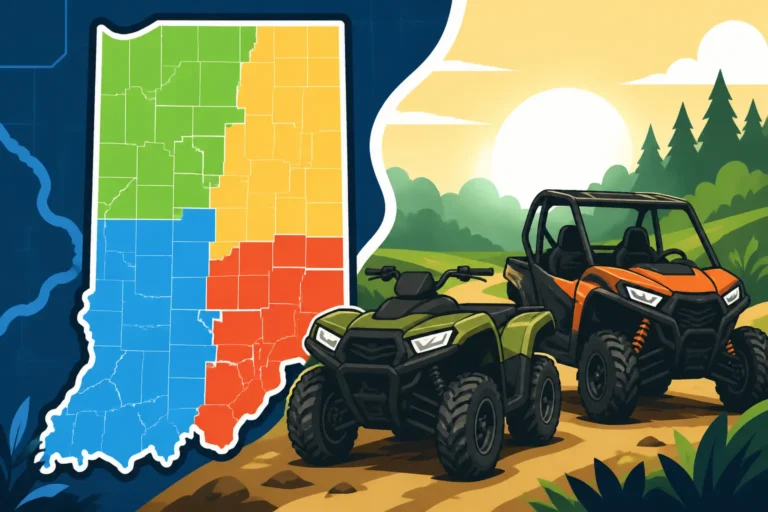
Vanderburgh County, home to Evansville, is one of the more proactive counties in Indiana when it comes to regulating ORV road use. They've gone above and beyond to provide clarity, publishing a detailed ordinance and even a color-coded map to show exactly which county roads are open and which are not. This level of specificity is incredibly helpful for riders. On their map, you might see certain roads designated with different colors, indicating varying conditions or restrictions. For example, a "blue" road might allow full ORV access, while a "red" road remains closed. This system helps riders understand their options at a glance. You can look at [Vanderburgh County's Marked Road Map] to see their approach. It's crucial to remember that even within Vanderburgh, riding within city limits, like Evansville or Darmstadt, typically remains prohibited, even if adjacent county roads are open. They often have rules about minimum age (e.g., 18 years old) and specific lighting requirements, making sure machines are adequately visible after dark. If you're looking for sturdy, reliable lighting upgrades, some riders turn to companies like SuperATV for their aftermarket options to meet or exceed these local safety standards.
Hancock County's Approach to Opening Roads
Moving a bit closer to Indianapolis, Hancock County has also enacted an ordinance to allow ORVs on certain county roads. Their approach tends to be a bit broader than Vanderburgh's detailed, color-coded map. Often, Hancock County's ordinance will designate all county roads within specific townships or outside municipal limits as open, with certain caveats. This can simplify things for riders in some ways, as it means less scrutiny of individual road segments. However, it's still vital to understand the boundaries – where county roads end and city or state roads begin. Always assume state highways and city streets remain closed unless explicitly stated otherwise by the relevant authority. Before you ride, it’s always a good idea to check out [Hancock County's Open County Roads] directly.
Dearborn County and Its Specific Section 70.04
In southeastern Indiana, Dearborn County also has an ordinance, specifically Section 70.04, that addresses ORV use on its roads. Like other counties, Dearborn has made provisions for riders, but again, with its own set of rules and limitations. Their ordinance might specify certain times of day for riding, speed limits, or particular areas where ORV access is restricted. It’s never a one-size-fits-all situation, and what you see in Dearborn County could be entirely different from the rules in Hancock or Vanderburgh. Always research [Dearborn County's Section 70.04] for the most accurate and current details before you plan a ride in that area.
Other Localities with Unique ORV Regulations
While these are prominent examples, other localities might have their own unique ordinances. Tell City, for example, is known for having its own municipal ORV registration system, which is quite unusual for an Indiana city. This highlights how deeply local control can sometimes go. In some areas, instead of a blanket opening, counties might only open very specific road segments that connect trails or allow access to rural properties. The key takeaway is that you cannot make assumptions. Every county, and even some cities, can have distinct rules.
| County/City | Status of ORV Roads (General) | Key Features/Restrictions | Notes for Riders |
|---|---|---|---|
| Vanderburgh County | Designated county roads open | Color-coded map (blue=open, red=closed), age 18+ requirement, insurance may be required, specific lighting rules. | Check official map on county website. Avoid city limits (Evansville, Darmstadt). |
| Hancock County | Most county roads open (outside city limits) | Broader designation, focus on county roads. | Confirm specific townships or areas covered. State highways are closed. |
| Dearborn County | Designated county roads open | Specific ordinance (Section 70.04) detailing rules, possibly time/speed restrictions. | Review Section 70.04 directly for details. |
| Tell City | Restricted but unique | Has its own city-level ORV registration system for approved use. | Special local registration needed for use within city limits. Highly unusual. |
| Most Other Counties | Closed by default | No specific ordinance opening roads. | Assume all county roads are closed unless explicit ordinance found. |
What Local Ordinances in Indiana Cannot Dictate for ORV Riders
While counties and cities have significant power to regulate ORV use on their roads, there are boundaries. The state of Indiana has established certain pre-emptive rules, meaning that local governments cannot create ordinances that contradict or go beyond what state law allows in specific areas. This is good news for riders, as it prevents a dizzying array of inconsistent demands that would be impossible to keep straight. It ensures a baseline level of uniformity on certain key aspects, even as local rules vary on others.
State Pre-Emption on Driver's License Requirements
One crucial area where state law pre-empts local authority is driver's license requirements. Unless you're operating an ORV on a state-designated road where a driver's license is explicitly required by state statute (which is rare for typical ORV scenarios), a county or city generally cannot demand that you possess a standard driver's license to ride your ORV on their designated local roads. This means that if a local ordinance states that you must have a valid driver's license to operate an ORV on county roads, that part of the ordinance may not be enforceable. The state defines [Indiana Driver's License Rules for ORVs], and localities cannot add to that. Of course, age restrictions for operating an ORV still apply, particularly for younger riders, which is a separate consideration from holding a driver's license.
Limitations on Weight or Size Restrictions
Indiana state law also defines what constitutes an "off-road vehicle" and sets some general parameters for their use. Local ordinances typically cannot impose arbitrary weight or size restrictions on ORVs that are more stringent than state definitions. For example, a county cannot simply ban all ORVs over 1,500 pounds if state law defines a broader category that includes heavier machines. They can, however, consider the impact of heavier machines on specific road surfaces, which might influence which roads they choose to open. But a blanket ban based solely on weight, if it contradicts state definitions, is generally not permitted. This provides some consistency for manufacturers and owners who have machines that fit the state's ORV criteria. If you've invested in a robust UTV, perhaps with heavy-duty components from SuperATV, knowing that its weight isn't going to suddenly make it illegal on a county road is reassuring.
Consistency in Helmet and Safety Gear Rules
While local ordinances might specify when an ORV can be ridden (e.g., daylight hours only) or where (e.g., paved vs. gravel roads), they cannot generally contradict Indiana's statewide helmet laws. [Indiana Helmet Law for ORV Riders] dictates that riders under the age of 18 must wear a helmet on public lands, including designated ORV trails and roads. This rule applies uniformly across the state, regardless of what a local county might try to dictate. So, if you're riding with a minor on a county road opened for ORVs, that statewide helmet rule still applies. Localities cannot loosen this requirement, nor can they typically add a requirement for helmets for adult riders where state law doesn't. They can, however, enforce existing state laws more rigorously.
Navigating City and Town Rules for ORV Riding in Indiana
While county ordinances can open up many opportunities for ORV riders, the rules often become much stricter when you enter the corporate limits of a city or town. This is where many riders get caught out, as they might assume that if a county road is open, the rules extend seamlessly into the adjacent municipality. Unfortunately, that's rarely the case. Cities and towns often have their own specific concerns regarding traffic, noise, and public safety, leading them to maintain much tighter restrictions on ORV use.
Generally More Restrictive Municipal Ordinances
Cities and towns, especially those with denser populations, generally adopt ordinances that are far more restrictive than their county counterparts when it comes to ORV use on public roads. The primary reason is often traffic safety and quality of life for residents. ORVs can be louder than traditional vehicles, and their presence on busy city streets can create hazards, especially at intersections or in areas with high pedestrian traffic. Therefore, it's common for city ordinances to simply ban ORVs from all public streets and alleys within their corporate limits, often with very few exceptions. This is a common point of frustration for riders who live in or near these areas and just want to get to a gas station or a local store.
Limited Exceptions: Crossing Roads or Special Permits
Even in cities and towns that largely prohibit ORV use, there might be very specific, limited exceptions. The most common exception is for crossing a road. For instance, an ordinance might allow an ORV to cross a city street at a right angle to get from one private property to another, provided the crossing is done safely, at a complete stop, and yielding to all traffic. However, these are typically brief, direct crossings, not prolonged riding down the street. In very rare cases, a city might issue special permits for parades, agricultural use within specific zones, or other sanctioned events. But relying on these exceptions for general recreational riding is almost never an option. Always understand [Indiana Rules for Crossing a Highway] before attempting it.
Why City and Town Rules Are So Important to Check
Ignoring city or town ordinances can quickly lead to citations and fines. Unlike sprawling county roads, city limits are often clearly defined by signage or the sudden change in infrastructure. An ORV operating on a busy main street in a town that prohibits such use is often highly visible and will attract the attention of local law enforcement. Before planning any ride that might take you into or through a populated municipal area, you absolutely must check the specific city or town ordinances. A quick call to the local police department or city clerk's office can save you a lot of trouble. What might be fine on a rural county blacktop could be a ticket-worthy offense just a few blocks away.
Practical Steps for Riding Legally on Indiana Local Roads
Figuring out the local rules isn't always straightforward, but with a bit of effort, you can arm yourself with the knowledge needed to ride legally and confidently. Nobody wants the hassle of a fine or a confrontation with law enforcement just because they didn't know a specific local rule. Taking a proactive approach will save you stress and ensure your rides are enjoyable.
Researching Your Specific Local Ordinance
The single most important step is to research the specific ordinances for the county, city, or town where you plan to ride. Don't rely on hearsay or what a friend told you. Official sources are your best bet. Start by visiting the county's official website – many counties publish their ordinances online in a searchable format. Look for sections related to "Off-Road Vehicles," "ATVs," "UTVs," or "Traffic and Highways." You might find a page dedicated to [Indiana Counties That Allow ORVs on Roads], which could serve as a starting point. If the information isn't readily available online, don't hesitate to call the county clerk's office, the county commissioners' office, or even the local sheriff's department (for county roads) or city police department (for city streets). They are usually happy to clarify the rules for recreational riders.
Contacting Local Officials for Clarification
Sometimes, even after reading an ordinance, there might be ambiguities or questions specific to your situation. This is when reaching out directly to local officials is invaluable. Call the county highway department to ask about specific roads, or the local police chief if you have questions about city limits. When you call, be polite, state your intentions clearly, and be specific about the roads or areas you're interested in. Taking a few minutes to clarify can prevent a misunderstanding that could lead to a ticket. It shows you're a responsible rider trying to follow the rules, which law enforcement officers generally appreciate.
Carrying Proof of Registration and Insurance
Even if your local roads are open, you'll still need to comply with statewide requirements. This includes having your ORV properly registered with the Indiana Bureau of Motor Vehicles (BMV) and displaying the current decal. [Registering an ORV in Indiana] is a non-negotiable step. The registration process itself incurs an [Indiana ORV Registration Cost], which helps fund trail maintenance. Always carry proof of your ORV registration and any insurance documentation that might be required by state or local law. Some counties, like Vanderburgh, specifically ask for proof of insurance when riding their designated roads. Keep these documents in a waterproof bag on your machine. Furthermore, ensure your [Indiana ORV Decal Placement] is correct and visible. An officer at a roadside stop will check for these things.
Adhering to All Safety Requirements and Signage
Finally, even on open local roads, common sense and safety are paramount. Observe all posted speed limits, traffic laws, and road signs. Your ORV should be equipped with appropriate lighting, especially if you plan to ride near dusk or after dark. This includes working headlights and taillights. Ensure your machine is in good working order, with functioning brakes and proper tires. If you're riding a side-by-side, make sure all occupants are wearing seat belts, and if required by age or location, helmets. Remember that state helmet laws, like [Indiana Helmet Law for ORV Riders], still apply even on local county roads. Always be visible, especially on roads shared with traditional vehicle traffic. Equipping your UTV with a solid roll cage, good mirrors, and maybe even a windshield from a reputable company like SuperATV can enhance safety and visibility, making you a more responsible rider. These upgrades are not just for comfort; they're for peace of mind when sharing roads.
Disclaimer
This article is for general informational purposes only and does not constitute professional advice. Laws, prices and regulations vary by location and change over time. Consult a qualified professional for guidance on your specific situation.