Riding Off a Marked Park Trail
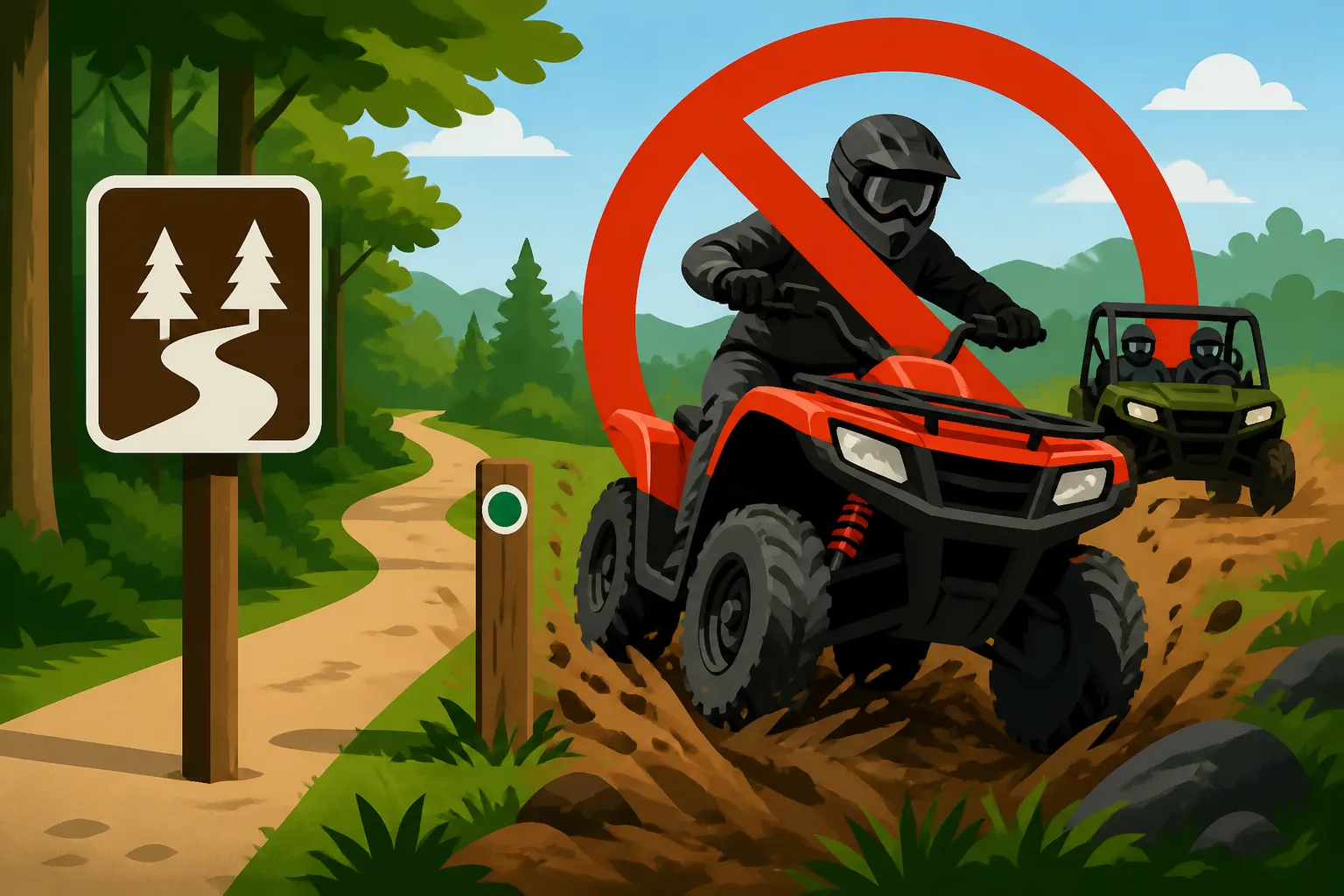
When a trail becomes hard to follow, it can be tempting to cut across open ground or make your own route back. At Indiana off-road parks, that can turn a moment of uncertainty into a rule violation. The practical answer is to stay on marked trails, recognize when a route is unclear or closed, and know what to do before riding farther.
What Indiana’s marked-trail rule means
At Indiana Department of Natural Resources (DNR) off-road properties, vehicles may be operated only in designated areas and must stay on marked trails, according to the Indiana DNR. An open-looking field, a gap between trails, or an old tire track is not automatically an authorized route. If it is not marked as a trail or otherwise designated for riding, do not treat it as one.
The rule matters even when the shortcut looks harmless. Leaving the route may put you into an area that is closed, unmarked, or not meant for motorized use. It can also make it harder to find your way back or bring you into conflict with riders who expect traffic to stay on the marked route.
A trail can be difficult to follow without being officially closed. Mud, brush, weather, or worn markings may make the route less obvious; that uncertainty does not give riders permission to extend the trail themselves. If you cannot tell where the marked route continues, stop somewhere safe and check the map, signs, or directions from park staff before proceeding.
The broad distinction is straightforward:
| What you see | Safer interpretation | What to do |
|---|---|---|
| A marked trail continuing ahead | The route is identifiable, but still check for closure notices | Stay on the marked route and follow posted instructions |
| A faint track heading away from the marked trail | It may not be an authorized trail | Do not follow it unless park staff confirms it is designated |
| A closure sign or barrier | The route is closed, even if it looks rideable | Turn back and use an authorized route |
| A missing or unclear marker | The route is uncertain | Stop, check available information, and ask staff |
| A way around mud, a blockage, or another obstacle | The detour may leave the designated route | Do not create a bypass; get direction from park staff |
For more detail on the boundary itself, see [Indiana Rules for Riding Off the Trail]. If a route is specifically closed, the separate issue is covered in Indiana Rules for Riding a Closed Trail.
Why a tempting detour is still a bad bet
Riders often leave a marked route for practical reasons: a muddy section looks difficult, a trail seems to disappear, or another track appears to offer an easier way around. But a detour can take you beyond the area open to riding. A route created by other riders does not prove that it is authorized, and a worn path is not a substitute for a park marker or staff direction.
There is also a difference between getting briefly disoriented and choosing to continue across unmarked ground. If you realize you have drifted off the trail, do not keep going in the hope that the ground will lead back to a route. Stop and work out your position using the map or other park information. If the safe way back is not clear, contact park staff rather than making a new track.
The Indiana DNR says all off-road vehicles at its off-road properties must stay on marked trails and be operated only in designated areas. That applies whether you are on an ATV, UTV, side-by-side, dirt bike, or another vehicle allowed at the property. The vehicle type does not make an unmarked route acceptable.
This is why a trail map and current property information are useful before unloading. Read the gate board and any trail notices, then compare them with the route you intend to ride. Reading the Gate Board Before You Unload and Checking an Indiana Trail Notice First can help you build that habit. If the map and a marker appear to disagree, pause and ask the park rather than guessing.
Weather and trail conditions can change how a route feels, but they do not change the marked-trail requirement. A soft section, puddle, or rut may make the trail slower or less comfortable. Do not respond by widening the trail or going around it across open ground. If the route seems impassable or unsafe, turn around if you can do so safely, and ask staff whether another designated route is available.
What to do when the route is unclear or blocked
A simple pause-and-check routine helps prevent a small navigation problem from becoming an unauthorized detour.
- Stop in a safe place. Avoid stopping where another rider could come around a bend and meet you unexpectedly. Keep your vehicle on the known trail if that is safe.
- Look for the next marker and any closure notice. Do not assume that a faint track is the continuation of the trail. Check for signs or directions that explain whether the route remains open.
- Check the property map or information you received at entry. Use it to compare your location and intended direction. A phone can be useful, but it should support the park’s route information rather than replace it.
- If you still cannot identify an authorized route, ask staff. Give them the trail or area you are near, if known, and describe what you see. Do not continue into unmarked ground to search for a better route.
- If you have already left the marked trail, stop extending the detour. Return to a known marked route only if you can do so safely and without crossing a closure or creating another unauthorized path. If you cannot, contact park staff for direction.
A paper map can be useful if a phone battery is low or reception is limited. A waterproof map sleeve or phone pouch can help keep route information usable in wet conditions; you can find options at outdoor retailers or on Amazon. Whatever you carry, make sure you can still read the park’s actual map and posted instructions.
If a marker is missing, damaged, or hard to see, tell staff where you found the problem. That is more useful than following another rider’s tracks or trying to mark a new route yourself. Park personnel can clarify whether the trail is open and whether the marking needs attention.
If you encounter a barrier or a posted closure, do not go around it. A closure may not be obvious from the condition of the ground, and the route’s appearance does not override the notice. For the relevant checks before setting out, see Checking an Indiana Trail Notice First.
Permits, registration, and other rules do not authorize off-trail riding
Trail access, vehicle registration, and permission to leave a marked route are separate matters. Having the right permit or registration does not allow you to ride wherever you choose inside a park.
The Indiana DNR states that a motorized trail-use permit is not an ORV registration. The permit relates to trail use at the applicable property; registration is a separate vehicle requirement. Indiana ORVs must be registered or street legal, according to the Indiana DNR. A trail permit does not remove the requirement to stay on marked trails.
Out-of-state visitors to Redbird Off-Road State Recreation Area and Interlake Off-Road State Recreation Area can purchase an Out of State Motorized Trail Use permit to ride at those two DNR properties, according to the Indiana DNR. The permit is limited to those properties and does not grant permission to ride off a marked trail. Visitors planning to use Indiana roadways open to ORVs have a separate registration question; see Indiana’s Out-of-State Annual Permit and Indiana’s Twenty-Day Visitor Rule for related information.
The daily receipt and other required paperwork should also be handled before riding. The Indiana DNR says the valid daily receipt must be in the vehicle operator’s possession at all times. That is an entry and compliance requirement, not a substitute for obeying trail markings. Showing a Permit at an Indiana Gate explains the practical side of keeping the required proof available.
Other park rules apply alongside the marked-trail rule. According to the Indiana DNR, children under 18 must wear helmets on or in an ORV in Indiana, including an ATV, UTV, side-by-side, or dirt bike. The Indiana DNR also requires functioning spark arrestors and mufflers on off-road vehicles at its off-road properties. Check the rules that apply to your vehicle and riders before leaving the staging area.
Use this quick separation to avoid mixing up different requirements:
| Requirement | What it addresses | What it does not allow |
|---|---|---|
| ORV registration or street-legal status | Whether the vehicle meets the stated vehicle requirement | Riding outside a designated area |
| Motorized trail-use permit | Access to applicable DNR trail property | Treating an unmarked route as open |
| Daily receipt | Proof the operator must keep in possession | Ignoring a closure or leaving the marked trail |
| Helmet and equipment rules | Rider protection and vehicle requirements | Making an otherwise unauthorized route permissible |
If you are uncertain whether a route is open, ask before riding it. A few minutes spent checking a map, reading posted notices, or speaking with park staff is a better choice than guessing and continuing onto unmarked ground.
Sources
- Indiana Department of Natural Resources — State Parks: ORV/Snowmobile Registration FAQs (checked November 3, 2026)
- Indiana Department of Natural Resources — State Parks: Motorized Recreation (checked November 3, 2026)
- Indiana Department of Natural Resources — State Parks: Motorized Recreation (checked November 3, 2026)
- Indiana Bureau of Motor Vehicles — Registrations & Plates: Off-Road Vehicles and Snowmobiles (checked November 3, 2026)
- Indiana Department of Natural Resources — State Parks: Off Roading on County Roads (checked November 3, 2026)
- Indiana Department of Natural Resources — State Parks: Interlake Off-Road State Recreation Area (checked November 3, 2026)
- Indiana Department of Natural Resources — State Parks: Redbird Off-Road State Recreation Area (checked November 3, 2026)
- Indiana Bureau of Motor Vehicles — Registrations & Plates: Off-Road Vehicles and Snowmobiles (checked November 3, 2026)
Disclaimer
This article is for general informational purposes only and does not constitute professional advice. Laws, prices and regulations vary by location and change over time. Consult a qualified professional for guidance on your specific situation.