Paying the Entrance Fee on Top
If you arrive at an Indiana off-road park expecting one payment to cover everything, the separate charges can feel like an unpleasant surprise. At participating state riding areas, a trail-use permit and a park entrance fee may both apply. This guide explains what each charge covers, when to expect both, and how to plan your visit without confusing one payment for the other.
Why Indiana may charge two separate fees
A trail permit and an entrance fee cover different things
A trail permit is tied to riding an off-road vehicle on designated trails. An entrance fee, when charged, covers access to the recreation area itself. They are separate requirements, so paying for one does not necessarily satisfy the other.
Think of a family driving to a riding area with two machines in a trailer. The trail permits address the machines’ use on the trails. The entrance payment addresses the group’s arrival at the park. Because the charges serve different purposes, the amount owed may depend on different details, such as the number of machines, who is entering, or whether the visit is covered by an eligible pass.
That distinction is easy to miss when you are buying permits online or reading a park’s information page. A permit confirmation may look like a complete receipt, but it does not automatically mean that an entrance charge has been paid. For a breakdown of the two payment types, see [Why an Entrance Fee Sits on Top in Indiana] and [Indiana's Daily and Annual Trail Permits].
The rules depend on the riding area and the visit
Do not assume every Indiana trail, private park, or recreation property uses the same fee arrangement. The entrance charge may depend on the particular site and the way it manages entry. A private off-road park, for example, sets its own admission practices, while Indiana’s state riding areas follow their own requirements.
This means the useful question is not simply, “Did I buy a permit?” It is, “What does this specific riding area require for this visit?” Check the park’s official information before leaving, especially if you are visiting a different property than usual, arriving during a special event, or using an annual pass. [Indiana State Recreation Area Entrance Fee] is a helpful topic to review when you are sorting out the entrance side of the bill.
| Payment | What it generally covers | What to confirm before leaving |
|---|---|---|
| ORV trail permit | Authorized use of designated trails by the covered machine | Whether each machine needs its own permit and which permit type applies |
| Park entrance fee | Entry to a particular recreation area, when charged | Whether the fee applies to your visit, who or what it covers, and whether a pass changes it |
| Private park admission | Access under the private park’s own rules | The park’s admission, riding, waiver, and operating requirements |
How to plan for both charges
Check the park’s requirements before buying
Start with the official page for the riding area you plan to visit. Look for separate information about trail permits and entrance or admission fees rather than relying on a single heading that says “fees.” Confirm the permit type, how it is purchased, and whether the park collects a separate entrance payment when you arrive.
If your group is going to a state riding area such as Redbird or Interlake, verify the requirements for that site specifically. Do not assume that a fee arrangement you encountered at one location applies at the other. Comparing the properties in advance can help you avoid surprises; [Indiana's Two State ORV Areas Compared] can help you think through which destination fits your trip.
Also check whether the requirements change for residents, nonresidents, annual pass holders, or special events. Those details can affect what you pay, but they are not a reason to guess. If a fee page is unclear, contact the park before loading the trailer. It is much easier to resolve the question at home than with machines unloaded and a line forming behind you.
Count machines and people separately
Before you calculate your trip budget, make two lists: the machines you plan to ride and the people or vehicles entering the property. A trail permit may be associated with a machine, while an entrance charge may be assessed under a different basis. Treating the whole visit as one lump sum can leave you short at the gate.
For example, a couple may bring two ATVs in one truck. They should check whether both ATVs need trail permits and separately check what the park charges for entry. A larger group arriving in several trucks should also ask whether entrance charges apply per vehicle or under another arrangement. The answer may differ from how trail permits are counted.
If you already have an annual permit or entrance pass, confirm exactly what it covers and whether it applies to the machines or visitors in your group. An annual trail permit should not be treated as a universal park admission pass unless the park explicitly says so. For machine-by-machine questions, see [Does Every Machine in the Truck Need Its Own Permit?].
Keep proof of payment easy to find
Save permit confirmations and receipts where you can retrieve them quickly, and keep any required permit information with the relevant machine. If you purchase online, take a moment to confirm that the transaction applies to the correct vehicle and visit. A receipt for one machine does not prove that another machine is covered.
It can also help to keep park entrance receipts separate from trail permit confirmations. When you are tired after a long drive or managing children, gear, and a trailer, two different payment records can blur together. A simple folder on your phone—or a printed copy stored with your riding paperwork—makes it easier to answer questions at the entrance.
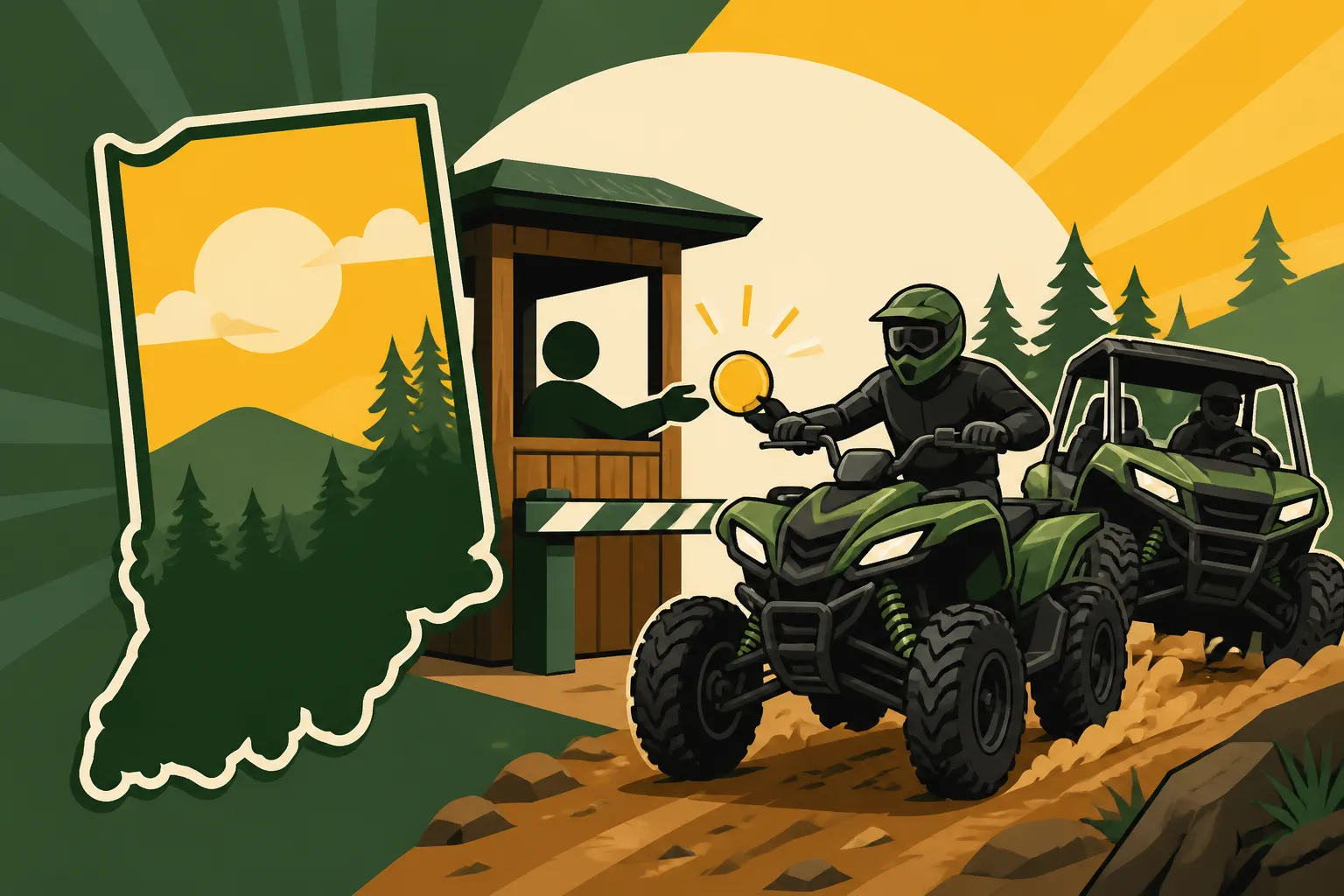
If the park uses a gate attendant or asks riders to show proof, have the confirmation ready before you reach the front of the line. Buying a permit in advance may save time on one part of the process, but it does not remove the need to follow the park’s entry procedure. See [Where to Buy an Indiana ORV Permit] and [Buying an ORV Permit Online Before You Leave Home] for help planning the permit purchase.
Avoid common fee misunderstandings
An online permit may not include admission
One of the most common mix-ups is seeing a payment confirmation and assuming it covers every charge for the day. Read the confirmation and the park’s entry information carefully. If the purchase page says it is for trail use, do not interpret that as proof that a separate entrance charge is included.
The reverse can also happen: paying at the park entrance does not necessarily mean you have permission to ride. Entry to the property and authorization to use motorized trails are different questions. Make sure you have satisfied both requirements when both apply.
Planning with a map can help you choose a destination and avoid an unplanned detour, but maps do not replace fee or closure information from the park. Some riders use onX Offroad to explore route options and get a sense of the area before a trip. Treat it as a planning aid, then check the riding area’s own rules and updates for permit, admission, and trail-access details. That extra check matters if your route could take you near property boundaries or areas that are not open to riding.
A pass may cover only part of the bill
An annual trail permit and an annual entrance pass are not automatically the same product. A pass may apply to trail use but not park entry, or it may cover certain entry charges without covering the permits required for each machine. Read the terms for the specific pass rather than relying on its name.
This is especially important when you ride often. A pass that makes sense for one part of the trip may not reduce the other charge. When estimating a season, list trail permits and entrance payments separately, then check whether any pass changes either line. [Indiana's Daily and Annual Trail Permits] and [Indiana State Recreation Area Entrance Fee] can help you keep those categories straight.
For visitors from another state, there may be additional permit rules to consider. Do not assume an out-of-state registration, decal, or park pass replaces Indiana’s trail-use requirements. Confirm the requirements for the machine and the park before you travel; [Indiana's Out-of-State Annual Permit] is a useful starting point for that question.
A practical checklist before you load
Confirm the charges for your exact destination
Use this short sequence before heading out:
- Choose the specific riding area and check its official entry information.
- Confirm whether a trail permit is required and which type applies.
- Check how many machines need permits.
- Look for a separate entrance fee, and confirm what it applies to.
- Verify whether any pass you own covers trail use, park entry, or both.
- Save permits, receipts, and any relevant confirmation details.
- Check operating hours, trail conditions, and closures before you leave.
The last step is worth keeping separate from the payment questions. A permit does not guarantee that every trail is open or suitable on the day you arrive. Weather, maintenance, or other park conditions can affect access. Check [Indiana Trail Conditions Before You Ride] before committing to a long drive.
Leave room for the unexpected
Even a well-planned visit can bring a small surprise: a gate process you have not used before, an additional vehicle in the group, or a pass that does not apply to the charge you expected. Build a little flexibility into your trip budget and avoid promising your group that one online payment covers the whole day until you have confirmed that detail with the park.
onX Offroad can be useful for scouting routes and organizing a trip plan, especially when you are comparing areas or coordinating with friends. Use it alongside—not instead of—the park’s official fee details and trail notices. If a route appears to connect to land outside the riding area, verify that access is actually permitted before riding there. A planned route is not a substitute for permission or an open trail.
The simplest approach is to think of the day as two possible steps: pay for authorized trail use, then meet the park’s entry requirements. When you check both separately, you are less likely to arrive at the gate with the right permit but the wrong expectation about admission.
Disclaimer
This article is for general informational purposes only and does not constitute professional advice. Laws, prices and regulations vary by location and change over time. Consult a qualified professional for guidance on your specific situation.