Why an Indiana Permit Is Per Vehicle
A group can arrive at an Indiana riding area with one annual permit and discover that it does not cover every machine in the trailer. The reason is simple: the permit is tied to a vehicle, not to its owner, household, truck, or riding group. Here’s how that rule affects ATVs and UTVs, what to check before you go, and how to avoid paying for the wrong permit.
What “per vehicle” means in practice
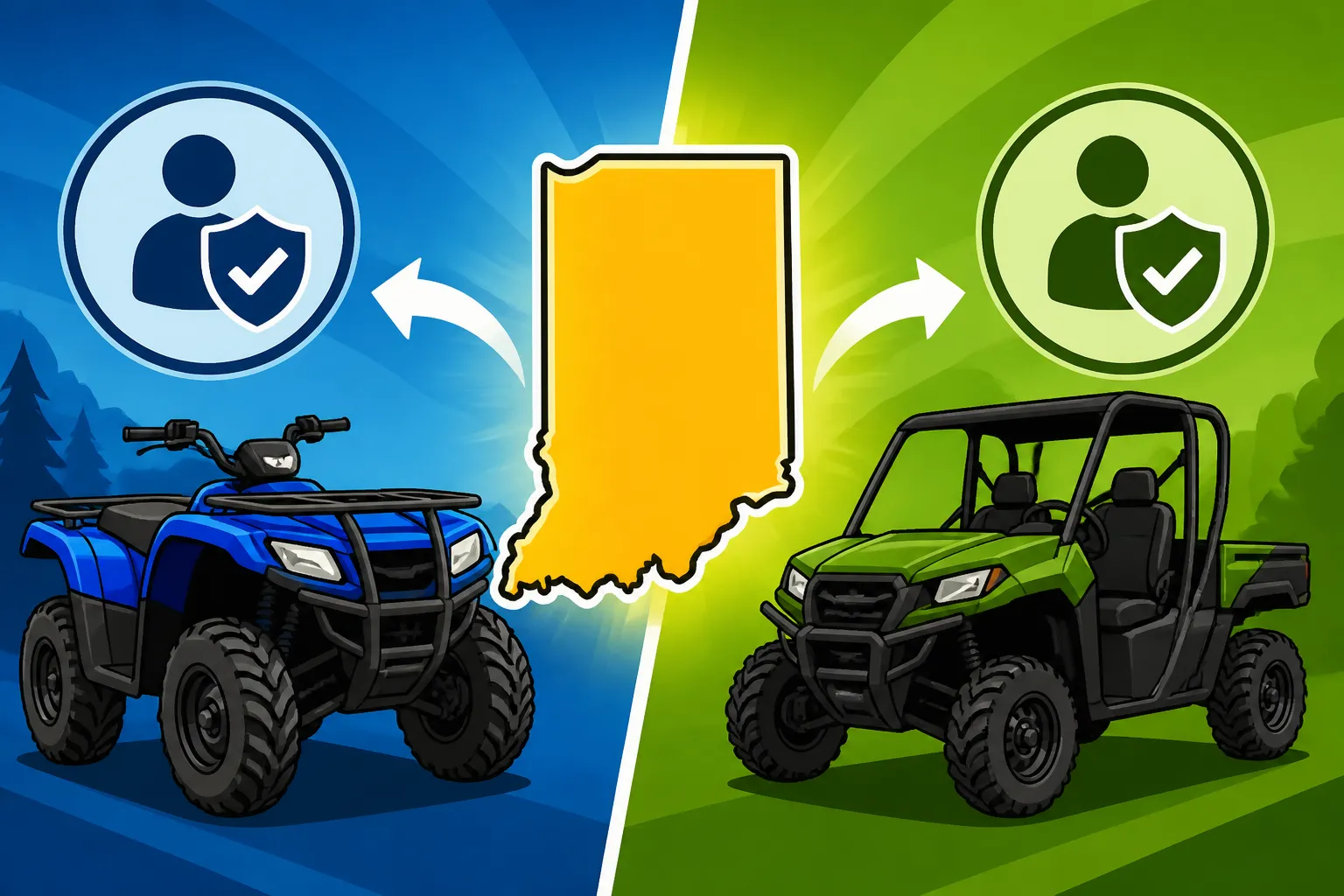
An Indiana ORV permit is not a group pass. If you are taking several machines to a place that requires a permit, plan on each machine needing its own permit. One permit does not cover every ATV or UTV owned by the same person, and it does not automatically transfer from one machine to another.
That distinction is easy to miss because people often organize a ride around a driver, family, or vehicle transporting the machines. But the permit requirement follows the off-road vehicle being used. If one pickup carries two ATVs and a side-by-side, the permit question applies to each of those three machines individually.
The same principle applies when people share machines. If a friend rides your permitted ATV while you take a second, unpermitted ATV onto a permit-required trail, your friend’s use of the first permit does not cover the second vehicle. The permit is not a transferable allowance for the person holding it.
A practical way to think about it is:
- One machine, one permit.
- A different machine needs its own permit.
- A permit for one vehicle does not cover a passenger’s separate machine.
- A permit does not necessarily cover entry or other park charges.
- The exact permit type depends on where you ride and the rules that apply there.
Indiana’s permit options and their limits are explained in Indiana’s Daily and Annual Trail Permits. The key point for a multi-machine trip is that choosing an annual rather than a daily permit does not turn it into a household or group pass. It remains associated with the vehicle for which it was issued.
The owner is not the unit of coverage
It may be tempting to assume that buying one annual permit covers all machines registered to your name. That is not a safe assumption. The permit is intended for a particular vehicle, so each ATV, UTV, or other covered ORV should be treated separately.
This matters for a family with multiple machines, a club carrying several members’ machines, a business with a small fleet, and anyone who owns both an ATV and a side-by-side. Ownership does not combine those vehicles into one permit unit. Nor does the number of people in the group change the requirement.
For instance, a household with two ATVs and one UTV should not plan on buying one permit and moving it around as riders switch machines. Before heading out, confirm the current permit requirements for each vehicle and obtain the right permit for each one.
“Per vehicle” does not mean “per person”
The reverse misunderstanding happens too: riders may think every person needs their own permit, even when they are sharing one machine. The relevant question is generally how many covered vehicles are being used, not how many riders are present.
A passenger riding in a permitted UTV is not a second vehicle. But a second ATV following behind is. A person who changes from riding one ATV to another should not assume the permit can move with them; check the permit’s terms and identification details instead.
This vehicle-based approach helps make sense of Indiana Permit for a Second Machine. If you add another machine to the trip, treat it as a separate permit decision rather than assuming the first permit expands to cover it.
Which trips need a permit, and which charges are separate
The per-vehicle rule matters only after you identify the kind of riding area and the applicable requirement. Indiana has public ORV areas, private parks, private land, and other properties with their own rules. A permit that applies in one setting should not be assumed to be a universal license to ride anywhere in the state.
Before a trip, find out whether the specific property requires an Indiana ORV permit, a separate park admission charge, a private-park pass, or some combination. A permit requirement and an entrance fee are not necessarily the same thing. Where both apply, paying one does not automatically satisfy the other. Why an Entrance Fee Sits on Top in Indiana explains why riders may encounter separate charges for permission to use trails and admission to a recreation area.
| Trip situation | What to check | How the per-vehicle rule affects you |
|---|---|---|
| One ATV at a permit-required public riding area | Which permit type is accepted and how it must be displayed | The permit is for that ATV |
| Several ATVs in one trailer | The permit requirement for each machine | Plan on a separate permit for each covered vehicle |
| A side-by-side plus an ATV | Whether both vehicle types are covered and how the permits are issued | Do not assume one permit covers both |
| A private riding park | The park’s current admission and vehicle rules | A state permit may not replace the park’s own requirements |
| Riding on private land | The owner’s permission and any rules that still apply | A trail permit does not give permission to use someone else’s property |
| Visiting from another state | Visitor, registration, and trail-permit requirements | An out-of-state registration does not automatically cover the trail permit |
| Renting a machine | What the rental includes and what remains the rider’s responsibility | Confirm whether the machine already has the required permit |
There are two common sources of confusion here. First, riders mix up a trail-use permit with a vehicle registration or decal. Second, they assume that paying at the gate covers every requirement. It may not.
An Indiana registration decal and a trail permit serve different purposes. Registration paperwork does not automatically replace a permit required at a particular riding area, and a trail permit should not be treated as proof that a vehicle has completed any separate registration requirement. If you are unsure which paperwork applies to your machine, start with Does Indiana Honor Out-of-State Registration? and then verify the rules for the exact property you plan to visit.
Likewise, an entrance payment may cover admission to the recreation area without covering the trail permit needed for each vehicle. Ask whether the amount due is for the machine, the riders, the park entrance, or some combination. That small question can prevent a frustrating surprise at the gate.
Public and private places can have different rules
Do not assume the same permit covers every destination on your itinerary. A state recreation area may have state permit requirements, while a private park may use its own day pass, waiver, admission system, or machine rules. Some places may ask for several things at once.
If you plan to ride at more than one property during a weekend, check each place separately. An annual permit accepted at one location does not necessarily satisfy the requirements at another, especially if the second location is privately operated. The park’s own instructions are the best guide to what must be paid for and displayed there.
For the same reason, do not treat a permit as landowner permission. On private land, get permission from the person entitled to grant it. A permit or registration document does not authorize trespassing, and a permit-required trail pass does not open unrelated roads or properties.
Visitors need to check more than the permit
Out-of-state riders may have a second layer of questions. Indiana’s visitor rules for registration are not identical to trail-permit rules. The permitted number of days an out-of-state machine may be operated in Indiana, where registration is recognized, and whether a trail permit is required are separate issues. Indiana’s Twenty-Day Visitor Rule and Indiana’s Out-of-State Annual Permit address those visitor-specific topics.
If you are crossing a state line for a weekend, check both the vehicle’s registration status and the riding area’s permit requirements. Do not assume that your home-state decal acts as an Indiana trail permit, or that an Indiana permit replaces required registration from your home state. Those are different documents with different jobs.
How to plan permits for a group or multi-machine trip
The easiest way to avoid a gate delay is to count machines before you buy anything. Count the ATVs, UTVs, dirt bikes, or other vehicles that will actually be used in the permit-required area. Do not count the trailer or tow vehicle as an ORV, and do not count passengers as separate machines. Then confirm the permit rules for each machine and the destination.
Use this process:
- List every machine that will be ridden. Include a machine that a family member might bring separately, even if it is not on your trailer.
- Identify each riding location. Check whether it is a public ORV area, private park, private property, or another type of site.
- Check the permit requirement at each location. Confirm which permit types are accepted and whether there are separate entrance charges.
- Match the permit to the vehicle. Do not plan to share, swap, or transfer a permit unless the issuing authority explicitly allows it.
- Follow the display instructions. Attach or carry the permit as directed, and keep any required supporting paperwork accessible.
- Recheck before leaving. Rules, fees, availability, and procedures can change, so confirm current details through the official or property-specific channel.
This process is more useful than buying a permit based on the number of adults in the group. A group of five people travelling on two machines is not the same permit situation as five people each riding their own machine. Count vehicles, then check the rules for those vehicles.
Example: a family bringing three machines
Suppose two adults bring a pair of ATVs and their teenager brings a youth machine. If all three will be ridden at a location requiring an Indiana ORV permit, plan around three vehicle-specific permits rather than one family permit. The teenager’s age may also affect supervision, helmet, or operating rules, but it does not make the other machines part of the youth machine’s permit.
If the family takes only one ATV on a later trip, the other permits do not become extra passes that can be assigned to any vehicle. Check the terms attached to each permit and whether it remains valid for the same machine and period. Avoid changing decals or other identifying material between machines without clear authorization.
Example: a club ride with several owners
A club may coordinate a convoy, share directions, and arrive together, but each member’s machine still needs to meet the applicable vehicle-level requirements. A leader buying a permit for their own ATV does not cover the rest of the group. The organizer can reduce confusion by asking members to confirm their own machine paperwork and permit before the ride.
For a larger group, a checklist can help:
- Rider’s name and contact information
- Machine type and identifying details
- Permit type and validity
- Required display location or method
- Entrance or admission requirements
- Any special rules for youth riders or passengers
The list does not replace official records; it simply helps the organizer notice a missing permit before the group is at the trailhead. A club with multiple machines should also be careful not to treat a group registration or event arrangement as a substitute for each vehicle’s individual permit obligations.
Example: a rental or borrowed machine
A rental machine may already have some required paperwork, but do not assume that it includes every permit or admission charge. Ask the rental provider what is included, which location the paperwork applies to, and whether the rider must buy anything separately. Indiana Rules for a Rented Machine is a useful starting point for rental-specific questions.
The same caution applies to a borrowed machine. Ask the owner which documents belong with it and whether the permit is valid for that exact vehicle and destination. If you bring another machine alongside it, the borrowed machine’s permit does not cover the extra one.
Buying, displaying, and keeping track of permits
Once you know what each machine needs, buy through the channel authorized for that permit and follow the instructions for delivery or display. Where to Buy an Indiana ORV Permit can help you locate the appropriate purchasing route. Before completing a purchase, confirm that you have selected the right permit type for the rider’s status, the vehicle, and the destination.
Do not assume that an online receipt is the same as a required decal or other permit credential. Read the confirmation carefully. It should explain what proof is issued, whether it must be attached to the machine, and what to do if the permit has not arrived before the planned ride. If the rules require a physical permit, a screenshot of an order confirmation may not be enough to satisfy a roadside or gate check.
The display instructions matter because permits are associated with particular vehicles. Keep the permit on the machine it was issued for, and make sure the placement is visible and secure as directed. Do not peel a permit off one vehicle and move it to another simply because both belong to you. If a decal is damaged, lost, or unreadable, ask the issuing authority about the proper replacement process rather than improvising.
For paper records, keep the order confirmation or other supporting document somewhere dry and easy to reach. A small waterproof document sleeve can protect paperwork from mud and rain. If you use a phone for a backup photo, make sure the image is legible and do not rely on it as a substitute for a physical credential when the rules require one. Amazon may be one place to find a basic sleeve, but the permit itself should be purchased only through an authorized channel. Amazon listings for accessories can vary, so check that any sleeve is large enough for the paperwork you need to carry. For a group ride, label the sleeve or folder by machine so the paperwork does not get mixed up in a shared gear bag.
A useful record for each machine can include:
- The permit type and purchase confirmation
- The vehicle’s identifying details
- The permit’s validity period
- Any instructions for displaying it
- The property or properties where it is accepted
- A note about separate admission or entrance charges
This does not need to become a complicated filing system. A folder in your phone or a labeled envelope in your gear can be enough. The important thing is that you can match each permit to the correct machine and show the necessary proof without searching through a pile of receipts at the gate.
Keep vehicle identification consistent
When two machines are similar, it is easy to mix up paperwork. Record a distinguishing feature for each one, such as its make and model, color, or vehicle identification number, and compare it with any information used when purchasing the permit. If the permit system asks for identifying details, enter them carefully.
A permit tied to one machine should not be treated as a floating credential for another machine of the same model. If the vehicle is sold, replaced, or substantially changed, ask the issuing authority what happens to the permit. Do not make assumptions about whether it can be transferred to a buyer or a replacement vehicle.
If your machine is rented, borrowed, newly purchased, or part of a fleet, clarify who is responsible for keeping its permit current. A dealer or rental provider may handle some paperwork, but that does not guarantee every riding-site requirement has been met. Check the documents rather than relying on a verbal assumption.
Common mistakes and a quick pre-ride check
The most frequent mistake is buying one annual permit and expecting it to cover a whole household. Close behind are confusing a trail permit with registration, assuming an entrance payment includes the permit, and thinking an out-of-state decal automatically meets every Indiana requirement.
These mistakes can be avoided by separating the questions:
- What is the machine? ATV, UTV, dirt bike, or another covered vehicle.
- Where will it be ridden? A particular public area, private park, or private property.
- What credential is required there? Registration, trail permit, admission, or more than one.
- How is each credential tied to the machine? Vehicle-specific display, paperwork, or other proof.
- What are the current instructions? Confirm with the permit issuer or property before the trip.
Before loading, make one final pass through the list:
- Count every machine that will be ridden.
- Match each machine with its own permit where required.
- Check that the permit is valid for the planned place and period.
- Confirm whether separate park admission is due.
- Check display requirements and make sure credentials are attached or carried as instructed.
- Verify any additional requirements for visitors, rentals, youth riders, or passengers.
- Keep receipts and supporting paperwork protected and accessible.
If one machine is added at the last minute, stop and check the requirement for that machine. Do not assume that a friend’s annual permit, a family member’s decal, or a receipt for a different vehicle will cover it. A few minutes spent confirming the details is easier than trying to solve a paperwork problem after unloading at the trailhead.
The rule is straightforward once you separate people from vehicles: the permit follows the machine it was issued for. Count vehicles, check the destination, and confirm how each permit must be displayed. That approach makes it much less likely that one unpermitted machine will hold up an otherwise well-planned ride.
Disclaimer
This article is for general informational purposes only and does not constitute professional advice. Laws, prices and regulations vary by location and change over time. Consult a qualified professional for guidance on your specific situation.