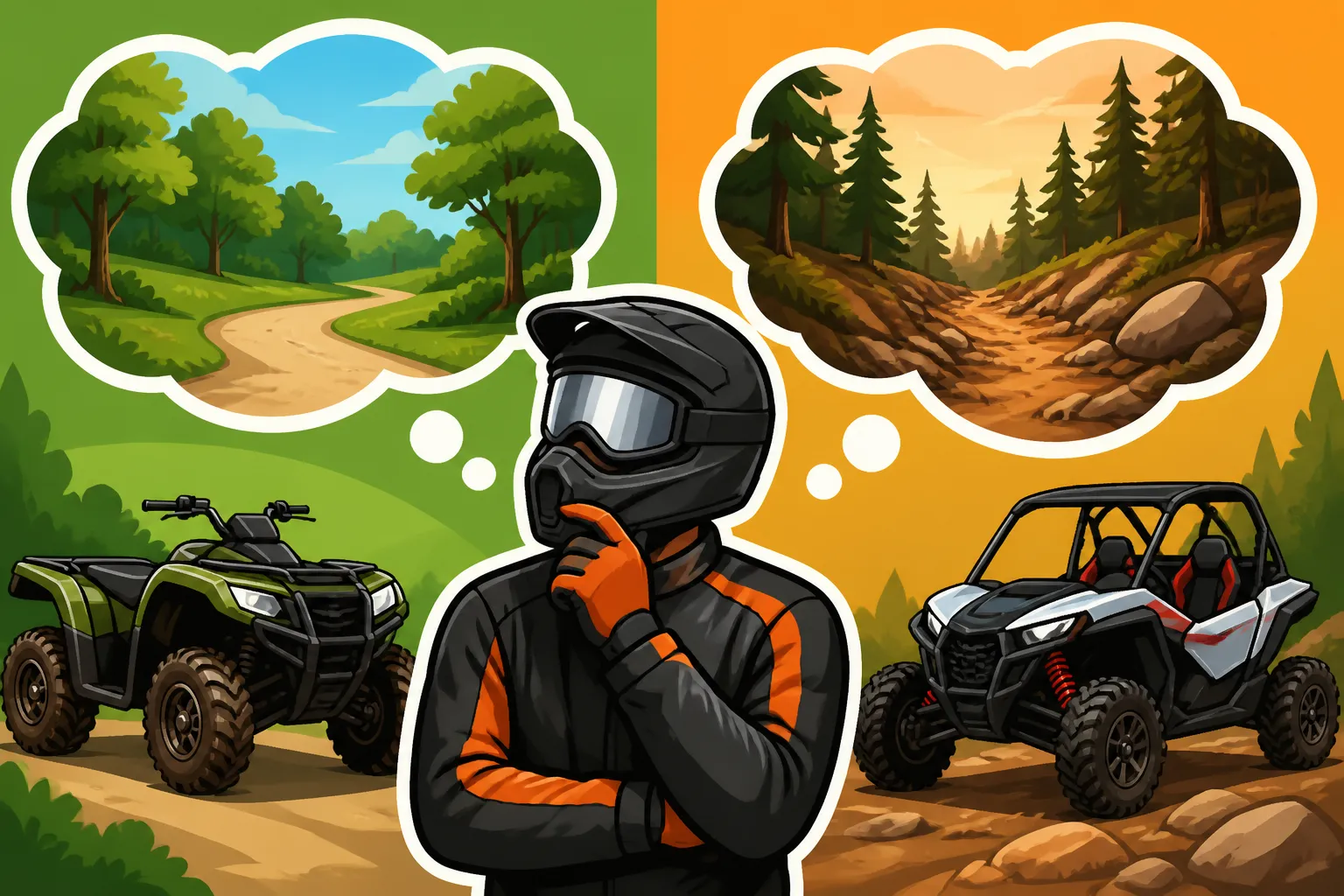
Which Park Loop Suits a First-Time Rider
A first ride at an Indiana off-road park can feel intimidating: the trail may look easy at the gate, then turn muddy, steep, or crowded once you’re committed. The right first loop is usually the shortest clearly marked route rated for beginners, chosen around your machine, recent weather, and comfort level. This guide explains how to pick that route at Indiana’s riding areas and when to turn back.
What makes a good first loop
Start with the trail rating, not the park’s reputation
A park’s overall reputation doesn’t tell you whether a particular trail is right for a new rider. Redbird and Interlake, for example, offer many miles of riding, but that doesn’t mean every trail is suitable for a first outing. Look for an official map or trail sign that identifies an easier route, then confirm that the route is open and appropriate for your vehicle.
If a map uses colors or difficulty labels, check its key before heading out. “Easy” should be understood as easier relative to that park’s other trails, not as a promise that the route is flat, dry, or obstacle-free. An easy trail can still have loose gravel, ruts, narrow turns, or hills that feel challenging when you’re learning to control a machine.
A good first loop gives you room to practice without putting you in a situation where you feel pressured to keep up. Take a look at Indiana Trail Difficulty Ratings and Indiana Trails for Beginners before you go. They can help you think about what a rating means and what kinds of trail features are likely to affect your comfort.
Choose a short route with an easy exit
For a first ride, prioritize a short loop or out-and-back trail that returns to a familiar staging area. A long route can be tiring even when the terrain is manageable. Fatigue often shows up as slower reactions, a heavier grip on the handlebars, and less patience when you encounter a hill or a group coming the other way.
A simple route also makes it easier to change plans. If you feel nervous after the first section, you can head back before that feeling turns into a stressful ride. If you’re comfortable, you can add another easy section after a break. That’s a much better first-day plan than committing to a big loop because it looked manageable on a map.
Before leaving the staging area, ask where the route reconnects, how to get back if you decide to stop early, and whether the trail has any junctions that are easy to miss. Maps from the park or land manager should guide your decisions; a planning app such as onX Offroad can help you review the general layout, but don’t treat it as a substitute for current signs, gate notices, or official trail information.
Match the trail to your machine and your confidence
A suitable route depends on the machine as well as the rider. A beginner on a small ATV may have a different comfort level from a beginner in a side-by-side. Check the park’s vehicle rules and the trail designation before setting off, especially if you are riding a wider or heavier UTV. A narrow route that feels manageable on a quad may be awkward in a side-by-side.
Think about what you’ve practiced, too. Have you already learned smooth throttle control, gentle braking, and how to stop on a slope? Can you turn around safely if the trail feels too difficult? If not, spend time in an open, permitted area or on the easiest marked section before trying a longer route.
You don’t need to prove anything on your first day. If a hill looks too steep, the mud is deeper than expected, or you’re unsure how to pass another group, stop somewhere safe and reassess. A first ride is successful when you return relaxed enough to want another one.
Choosing among Indiana riding areas
Redbird near Dugger
Redbird Off-Road State Recreation Area, near Dugger in Sullivan County, is a major destination for off-road riders. Its reclaimed-mine terrain can include changing surfaces and elevation, so first-timers should avoid assuming that a trail will stay consistent from start to finish. Conditions, recent rain, and the specific marked route all matter.
For a first visit, look for the easiest currently open route on the official map and ask staff or the gate team what’s reasonable for a new rider that day. A dry stretch can still have uneven ground or climbs, while rain can change the feel of clay and create slippery ruts. If your group includes riders with very different experience levels, agree that the least experienced person sets the pace.
Start with one short section, take a break, and decide whether to continue. You can read more about planning a visit in Riding Redbird for a Day and Indiana’s 1,400-Acre Redbird. Those topics can help you get familiar with the setting before you unload.
Interlake near Lynnville
Interlake Off-Road State Recreation Area near Lynnville spans areas of Pike and Warrick counties and offers a large network of trails. That variety is appealing, but it also makes route selection important. A long trail network can be confusing if you leave without a clear plan, especially when you’re still learning how quickly your group rides and how long a break takes.
Choose a short, clearly marked beginner route and identify the turns that lead back toward your starting point. If the map has several connecting trails, mark the route you intend to use before you ride. onX Offroad may be useful for reviewing the general layout in advance, but confirm directions against official park maps and posted information. Keep your phone charged and don’t rely on cell service to navigate.
Interlake’s size can make it tempting to cover as much ground as possible. Resist that urge on a first visit. A compact ride with time to stop and regroup is usually more enjoyable than an ambitious route that leaves everyone tired or uncertain. For a fuller look at planning a visit, see Riding Interlake for a Weekend and Indiana’s Two State ORV Areas Compared.
Private parks such as Haspin Acres and Badlands
Private parks can be another option, but their terrain, rules, trail markings, and access arrangements differ. Haspin Acres near Laurel and Badlands Off Road Park near Attica are examples of private riding destinations. Before choosing one for a first ride, check the park’s current map and rules, including which trails are open to your type of machine and whether a beginner area or easier route is available.
Don’t assume that a trail marked as a loop is automatically a beginner loop. Ask what the route is like in the conditions you’ll encounter, and whether a new rider can turn around or return to the staging area without taking a more difficult connector. If you’re unsure, ask park staff which short route is best for a first-time visitor rather than relying only on online descriptions.
| Riding area | A sensible first-ride approach | What to confirm before unloading |
|---|---|---|
| Redbird near Dugger | Begin with the shortest clearly marked easy route | Current closures, surface conditions, and route back to staging |
| Interlake near Lynnville | Plan a compact route through the larger trail network | Junctions, open trails, and the best beginner option for your machine |
| Haspin Acres near Laurel | Ask staff about a short route suited to your experience | Park-specific rules, trail access, and whether conditions have changed |
| Badlands near Attica | Use the current park map and avoid routes beyond your comfort level | Vehicle restrictions, trail status, and available easier terrain |
This is a planning comparison, not a guarantee that a particular route will be easy on a given day. Weather and trail conditions can change the experience quickly.
Plan the route before you ride
Read the map and ask about conditions
Use the official map for the riding area as your primary guide. Look for trail difficulty, closed sections, one-way directions, staging areas, and connectors. If the map is hard to read, ask someone at the entrance to point out a short route and explain how to get back. It’s much easier to ask while you’re parked than after you’ve reached an unfamiliar junction.
Check conditions close to your visit. A route that was comfortable during a dry spell may be slick or deeply rutted after heavy rain. Clay and reclaimed ground can be especially different under wet conditions, and a trail that feels manageable under your tires may become difficult for a rider who is still learning. Review Indiana Trail Conditions Before You Ride and Indiana Trail Closures to Check First as part of your planning.
If you use onX Offroad, review your intended route ahead of time and save the information you’ll need for the trip. Still, confirm that the trail is open and that the route shown is allowed for your vehicle. Posted signs and park instructions take priority over a saved track or a line on a screen.
Set a pace and agree on a turnaround plan
Before leaving the staging area, agree on a few simple expectations: who leads, who rides last, where the group will stop, and what to do if someone wants to turn back. New riders often feel awkward saying that a trail is too difficult, especially when riding with friends who have more experience. Make it clear that anyone can call for a pause without having to justify it.
Keep enough space between machines to see the trail and react to changes. Don’t ride so close that you’re pressured to match someone else’s speed. On a narrow section, stop in a safe place if you need to let another group pass. Indiana Trail Etiquette on Shared Ground offers more guidance for sharing trails and keeping a group ride comfortable.
Plan a turnaround point before you start. It could be a signed junction, a recognizable feature, or the point where the route begins to feel beyond your ability. Turning back is not a failure. It’s a sensible way to protect the rest of the ride—and it keeps your first experience from becoming an exhausting recovery mission.
Bring the basics and respect park rules
Pack water, appropriate riding gear, and a charged phone. Carry the items the park requires, and make sure you understand permit, entrance, and vehicle rules before arrival. If your machine has a problem or someone in your group gets separated, knowing where you started and which route you planned can save time and reduce stress.
Follow posted directions, stay on marked trails, and avoid riding around a closure. Closed sections may be unsafe, under repair, or protected for another reason. If you’re uncertain about a route, stop and check rather than guessing. For a broader overview of permitted areas and closures, see Where to Ride an ORV in Indiana.
A first visit also goes more smoothly when you arrive with enough time to get oriented. Unload, check your machine, look at the map, and ask questions before you feel rushed to join the trail. Choosing a slightly shorter ride leaves room for a meal, a repair, or a change in weather without making the day feel like a disappointment.
A practical first-ride decision
Use this quick checklist at the trailhead
Before starting, answer these questions:
- Is the route officially marked as open and suitable for my type of machine?
- Is it the shortest reasonable option for a beginner, or can I choose a shorter section?
- Do I know how to return to staging if I feel uncomfortable?
- Have I checked the map, signs, and current conditions?
- Does everyone in my group agree to ride at the least experienced person’s pace?
- Do I have water, appropriate gear, and the required park materials?
If you can’t answer one of these questions, pause and ask. That brief conversation can prevent a confusing or unpleasant ride later.
Let the day’s conditions make the final call
The best loop is not necessarily the one with the most scenic view or the most miles. It’s the route that gives you a manageable challenge in the conditions you actually face. If rain has made the ground slick, choose a shorter and easier option. If the trailhead is crowded, take extra care at intersections and avoid trying to keep up with riders who are moving faster.
For many first-timers, the best plan is to ride one easy section, stop, and decide whether to continue. You’ll learn how your machine responds, how quickly you tire, and what kinds of terrain make you uneasy. That information will help you choose a more adventurous route next time—and enjoy it more.
Pick a loop you can finish comfortably
At Redbird, Interlake, Haspin Acres, Badlands, or another Indiana riding area, base your first route on official trail information, current conditions, and your own comfort level. Start short, follow marked routes, and choose a path back to staging before you go. If the trail feels harder than expected, turn around while you still feel in control. A calm first ride is a better foundation than a long ride you spend wishing were over.
Disclaimer
This article is for general informational purposes only and does not constitute professional advice. Laws, prices and regulations vary by location and change over time. Consult a qualified professional for guidance on your specific situation.