Where the BMV Decal Goes on Your Frame
You’ve done the hard part: you’ve navigated the Indiana Bureau of Motor Vehicles (BMV) system, submitted all your paperwork, and now that shiny new ORV decal has landed in your mailbox. It's a small but mighty sticker, essential for legally riding your ATV or UTV in the Hoosier State. But then comes that moment of pause – where, precisely, does this crucial piece of identification actually go on your machine? Sticking it just anywhere won't cut it, and knowing the correct spot can save you a headache (and a potential fine) down the line. This guide is here to clear up that confusion, ensuring your decal is perfectly placed and ready for inspection.
The Indiana BMV Decal: Your Machine's Official ID Tag
First things first, let's understand what this decal signifies. When you complete the process of [Registering an ORV in Indiana], the BMV issues a unique registration number and a corresponding decal. This decal isn't just a fancy sticker; it's your machine's official proof of registration, signifying that you've paid the necessary fees and are legally permitted to operate your off-road vehicle where allowed. Think of it like a license plate for your car, but specifically for your ATV, dirt bike, or side-by-side.
The decal itself is designed to be durable, meant to withstand the elements you'll encounter on Indiana's trails and riding areas. It typically features the registration number, the expiration date, and usually the state's name or logo. Since [Indiana's Three-Year ORV Registration] period means this decal will be on your machine for a while, its proper application and placement are absolutely essential. An officer checking your machine roadside will look for this decal, so its visibility and legibility are paramount. Without it, or if it's placed incorrectly, it's as if you're riding an unregistered machine, which can lead to significant issues.
Why Every ORV Needs This Decal
Beyond just being a legal requirement, the decal serves several practical purposes. It helps park rangers and law enforcement quickly verify your compliance without having to ask for your physical paperwork every single time. It also contributes to public safety and proper trail management. The funds generated from ORV registrations, in part, go towards maintaining and improving Indiana's off-road riding opportunities. When you display your decal correctly, you're not just following the law; you're also showing support for the trails you love.
Consider a scenario: you're pulling into Redbird SRA for a day of riding. The park attendant or conservation officer at the gate will often do a quick visual check for your decal. If it's missing, obscured, or on the wrong part of the machine, they might hold you up, ask for your paperwork, or even deny entry until the issue is resolved. This is why understanding [The Indiana ORV Decal Explained] is so important—it's your gateway to hassle-free riding.
Pinpointing the Decal's Home: The Forward Half of Your Frame
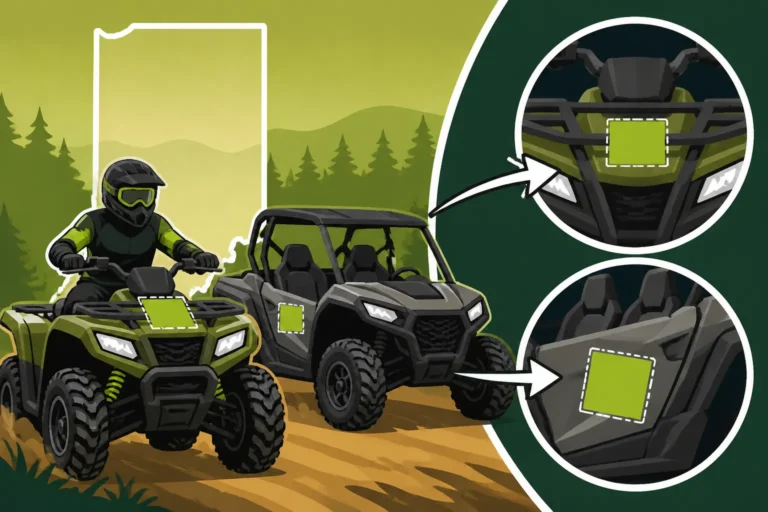
Now, for the big question: where exactly does that BMV decal need to go? Indiana law is quite specific on this, even if the wording can sometimes leave new owners scratching their heads. The regulation states that the decal must be "permanently affixed to the forward half of the machine's frame." Let's break down what that really means for your specific machine.
The "frame" refers to the main structural chassis of your ATV or UTV – not the fenders, plastic bodywork, or engine casing. It's the bare bones, the metal skeleton that holds everything together. The "forward half" means just that: imagine drawing an imaginary line directly through the middle of your machine from front to back. The decal needs to be somewhere between the front bumper and that midpoint line, directly on the frame. This ensures it's easily spotted from the front or side of the vehicle.
Identifying the "Forward Half" on Your Machine
For most ATVs and dirt bikes, the frame is pretty exposed. You'll often find a good spot on one of the main frame rails near the handlebars, below the fuel tank, or perhaps on a strut closer to the front suspension. For side-by-sides, which have more bodywork, you might need to look a bit harder. Check the main frame rails that run under the front seats, or perhaps a section of the roll cage structure that's clearly part of the main frame and visible. The key is visibility and permanence. It shouldn't be somewhere that's easily covered by mud, obstructed by accessories, or hidden from view during a quick visual check.
Take a moment to examine your machine's design. On a quad, many riders find a suitable, flat spot on the main steel or aluminum frame tube running from the steering head down towards the footpegs, or sometimes on the frame section that supports the front fenders. For a UTV, you might find a vertical or horizontal frame member near the front suspension towers or just behind the front wheel well. The important thing is that it's on the primary structural element, not on an auxiliary bracket or plastic panel. This aligns perfectly with [The Forward Half of an Indiana Machine] specification.
Practical Placement Considerations
Beyond the legal requirement, consider the practicalities. You want to place it somewhere that minimizes its exposure to direct impacts, extreme abrasion, or constant flexing. While it's meant to be durable, a direct hit from a rock or constant rubbing against your boot could damage it over time. Choose a relatively flat, clean surface. Before applying, thoroughly clean the chosen area with rubbing alcohol to remove any grease, dirt, or wax. This ensures maximum adhesion and prevents the decal from peeling prematurely. Press it firmly from the center outwards to avoid air bubbles.
You also want to consider visibility from both sides if possible, though the law only states the forward half. If an officer approaches from either side, you want them to be able to see it without difficulty. If your machine's frame allows for symmetrical placement, that's often ideal. Remember, the goal is for the decal to be clear, distinct, and undeniable proof of your registration. It's not just for aesthetics; it's a vital part of staying legal on the trails.
The Importance of Proper Placement and Upkeep
Improper placement of your BMV decal might seem like a small detail, but it can lead to bigger problems. An Indiana conservation officer or park ranger is trained to look for these decals in their designated spot. If they can't find it, or if it's incorrectly placed, faded, or damaged, it can raise questions about your machine's registration status. This could lead to a delay in your riding plans, an in-depth inspection of your paperwork, or even a citation for riding an unregistered ORV.
The consequences of an [Indiana Fines for an Unregistered ORV] can be quite substantial, easily outweighing the minor effort of correctly placing your decal. Beyond the legal ramifications, a properly placed and well-maintained decal reflects responsible ownership. It shows that you understand and respect the regulations designed to keep off-roading safe and sustainable for everyone in Indiana.
What an Indiana Officer Checks Roadside
When an officer conducts a roadside stop or a check at a trail entrance, they're looking for several things. They'll verify your identity, check for safety equipment like helmets (especially for younger riders), and of course, confirm your machine is legally registered. Part of this check involves a visual scan for the BMV decal. They'll specifically look at [What an Indiana Officer Checks Roadside], and a clearly visible decal on the forward half of your frame makes their job (and yours!) much easier.
If your decal is missing, obscured by mud, or peeling off, they might then ask to see your physical registration certificate. While you should always carry this with you (perhaps a laminated copy or a clear photo on your phone), having the decal readily apparent is the primary proof. This is also where good record-keeping comes into play. Keeping organized files of your purchase, registration, and title documents – perhaps even utilizing a service like LawDepot for important legal forms like a bill of sale – can streamline any necessary interactions.
Maintaining Your Decal for its Full Three-Year Lifespan
Given that your ORV decal is valid for three years, you need to ensure it stands the test of time and the elements. Here are some tips for maintaining its integrity:
- Cleanliness: Regularly clean the area around the decal, but avoid harsh chemicals or abrasive scrubbing directly on the decal itself. A gentle soap and water solution is usually sufficient.
- Protection: While you can't prevent all trail hazards, be mindful of where the decal is. If you're adding accessories, ensure they don't rub against or obscure the decal.
- Inspections: Periodically check the decal for signs of wear, fading, or peeling. It's much easier to address a small corner lifting than to find the entire thing gone.
- Documentation: Always keep a digital photo of your decal, especially after it's applied, and have your physical [Indiana ORV Registration Paperwork] accessible.
Should your decal become damaged or lost, don't wait until you're at a trail entrance to find out it's a problem. Proactively inquire about [Replacing a Lost Indiana ORV Decal] through the BMV. It's a straightforward process that ensures you remain compliant. If you ever find that [When Mud Peels Your Registration Decal Off], it’s always best to order a new one rather than risk a fine.
Summary of Decal Placement and Best Practices
To help summarize these crucial points, here's a quick overview of what to remember about your Indiana BMV ORV decal:
| Feature | Requirement / Best Practice |
|---|---|
| Location | Must be "permanently affixed to the forward half of the machine's frame." This means the main structural chassis, not plastic bodywork, and positioned between the front bumper and the vehicle's midpoint. This is a specific instruction often referred to as [Indiana ORV Decal Placement]. |
| Visibility | Ensure the decal is clearly visible and not obscured by mud, accessories, or other vehicle parts. It should be easily readable from a reasonable distance. |
| Adhesion | Clean the application surface thoroughly before applying the decal. Use rubbing alcohol to remove grease and dirt, ensuring maximum stick. Press firmly from the center outwards to prevent bubbles. |
| Legibility | The registration number and expiration date must remain clear and readable for the entire three-year registration period. Protect it from excessive wear or chemicals that could cause fading. |
| Maintenance | Periodically check the decal for signs of peeling, fading, or damage. Clean it gently with soap and water, avoiding abrasive cleaners. |
| Documentation | Always carry your physical [Indiana ORV Registration Paperwork] or a clear digital copy. Consider retaining copies of important documents like a bill of sale, which you can create using services like LawDepot, alongside your registration for a complete record. |
| Replacement | If the decal is lost, stolen, or becomes unreadable, immediately contact the Indiana BMV to order a replacement. Don't ride with a damaged or missing decal. [Ordering a Replacement Indiana Decal] is a relatively simple process. |
Getting your decal placement right is a small but critical step in ensuring you have a smooth and enjoyable off-road experience in Indiana. It helps you stay legal, supports the trails, and prevents unnecessary delays or fines. So, take a moment to find that perfect spot on your machine's frame, clean it well, and apply that decal with care. Then, you're truly ready to hit the trails with confidence.
Disclaimer
This article is for general informational purposes only and does not constitute professional advice. Laws, prices and regulations vary by location and change over time. Consult a qualified professional for guidance on your specific situation.