Indiana ORV Registration for a Lodge
It can be incredibly confusing for a lodge owner in Indiana to figure out the ins and outs of Off-Road Vehicle (ORV) registration. You've got machines for property maintenance, maybe some for guest activities, and others for staff use, and it's easy to assume they all fall under one umbrella – or worse, that they don't need registration at all because they're on "private" property. But the reality is far more nuanced, and failing to properly register and title your lodge's ORVs can lead to unexpected fines, legal headaches, and operational disruptions. This comprehensive guide will walk you through everything a lodge owner needs to know to keep their ORV fleet legal and running smoothly in the Hoosier State.
Understanding Why a Lodge Needs to Register Its ORVs
Operating a lodge often means having a fleet of vehicles to help with everything from groundskeeping to guest experiences. While you might think of ORV registration as something only personal recreational riders need, the rules in Indiana apply broadly, especially when commercial operations are involved. It's not just about hitting the public trails; it's about formal ownership and accountability.
The Legal Requirement for Business-Owned Machines
The state of Indiana doesn't differentiate much between an ORV owned by an individual for weekend fun and one owned by a business, such as a lodge, for commercial purposes. If an ORV meets the state's definition – generally, a motorized vehicle designed for off-road use, weighing less than 9,000 pounds, and not designed for highway use – it typically needs to be registered. This requirement ensures that the state has a record of the machine and, crucially, that fees are collected to support the very trails and resources ORVs utilize. It's a system designed for tracking and funding, and businesses are part of that ecosystem.
Many lodge owners mistakenly believe that because their machines primarily operate on their own sprawling private property, they are exempt from state registration. However, this is a common pitfall. If any portion of your property is accessible to the public, or if your machines ever touch a public road (even to cross it) or connect to designated public trails, they absolutely must be registered. Even if your machines are strictly on private, inaccessible land, proper titling is still a critical step for proof of ownership, especially for a business asset.
Common Lodge Uses Requiring Registration
Lodges use ORVs in countless ways, and almost all of them trigger the need for registration. Think about the variety of tasks and activities that might involve an ATV or UTV on your property. Each use carries its own layer of regulatory consideration.
Firstly, if your lodge offers ORVs for rent to guests, these machines are unequivocally subject to full registration and titling requirements. They are being operated by multiple individuals, often on parts of your property that may be deemed "open to the public" in a practical sense, and sometimes they may even be driven to access nearby public trails. The liability and regulatory scrutiny increase significantly with rental fleets, making proper documentation paramount. Guests expect a safe and legal experience, and that starts with the lodge's compliance.
Beyond rentals, many lodges use ORVs for core operational tasks. This could include hauling firewood, plowing snow from access roads in winter, transporting supplies across large properties, or moving guests and their luggage between cabins and central facilities. If these utility vehicles ever leave the immediate footprint of your central buildings and venture onto trails or roads, they need that Indiana ORV registration. Even if they stay entirely on private access roads that aren't technically public, having them registered still provides crucial documentation of ownership, which is vital for insurance purposes and asset management for your business.
Finally, consider machines used for promotional events, guided tours on your property, or for staff transport on vast grounds. Even if a machine is only used by trained staff, its commercial application brings it under the state's watchful eye. For example, if your lodge advertises "guided ATV tours" on your property, the machines used for those tours must be registered. This isn't just a suggestion; it's a legal mandate that protects both your business and your guests. Understanding [Registering an ORV in Indiana] is your first step.
The Registration Process for a Lodge's ORVs
Navigating the registration process for a single personal ORV can feel like a maze, so doing it for a fleet of lodge-owned machines might seem daunting. However, by breaking it down into manageable steps and understanding the specific requirements for businesses, it becomes much more straightforward. The key is to be meticulous and treat each machine as a distinct asset requiring its own set of compliant documents.
Gathering the Necessary Paperwork
Just like any vehicle registration, the process for a lodge's ORVs hinges on having the correct documentation in order. This isn't just busywork; it's proof of legal ownership and proper acquisition. For a business, this record-keeping is even more crucial. You'll need solid proof of ownership for each machine, typically a manufacturer's certificate of origin (MCO) for new machines, or a clear title or [An Indiana Bill of Sale for an ORV] for used ones. If you're purchasing from a dealer, they should provide all necessary paperwork.
For used machines acquired from private sellers, a well-drafted bill of sale is essential. It must contain specific details about the ORV (VIN, make, model, year) and the buyer and seller information. Remember, a simple handwritten note might not suffice for the BMV. If your lodge is buying a used machine and the previous owner never properly titled it, or if the paperwork is missing, you might need to file an [Filing an Ownership Affidavit for a Quad With No Paperwork]. This is a formal sworn statement establishing your lodge's ownership. Legal document services like LawDepot can be invaluable for creating official, legally sound bills of sale or ownership affidavits, ensuring you meet all state requirements and avoid future complications.
Beyond proof of ownership, your lodge will need to provide its business information. This includes your Federal Employer Identification Number (FEIN), official business name, and address. The BMV needs to know that the registering entity is a legitimate business. Keep copies of all business registration documents handy, such as your Articles of Incorporation or LLC formation documents, as these might be requested to verify your business's legal standing. Getting all this paperwork organized before you even step foot in a license branch will save you a lot of time and frustration.
Where and How to Register Lodge Machines
Once you have all your documents in order, the next step is to physically complete the registration. In Indiana, ORV registration is handled by the Indiana Bureau of Motor Vehicles (BMV) or any authorized license branch. You can't just send a junior staff member without proper authorization; someone with legal authority for the lodge (an owner, manager, or authorized agent) will need to be present to sign off on the applications.
While most individuals visit a local license branch, if you have a large fleet, it's worth inquiring with the BMV directly about potentially streamlining the process. Some states have special provisions for commercial fleet registrations, though Indiana's system is generally decentralized to local branches. Don't assume anything; confirm the best approach for multiple machines. The BMV website also offers information on [Indiana ORV Registration Online] for renewals, but initial registrations usually require an in-person visit, especially when dealing with titles and business documentation.
When you register, you'll pay the necessary fees for each machine. After the initial registration, you'll receive a registration certificate and an ORV decal for each machine. The decal is your proof that the machine is legally registered for operation in Indiana. Understanding [Where to Register an ORV in Indiana] is crucial to ensure you go to the right place and have a smooth experience.
Understanding the Fees and Decals
Registering your lodge's ORVs comes with specific fees, and it's essential to budget for these as part of your operational costs. Each machine in your fleet will incur a registration fee, which is typically a flat rate for a three-year period. There's also a separate titling fee for machines that require a title (which is most of them if purchased after 2009). These fees contribute to the state's ORV fund, which helps maintain trails and promote safety programs.
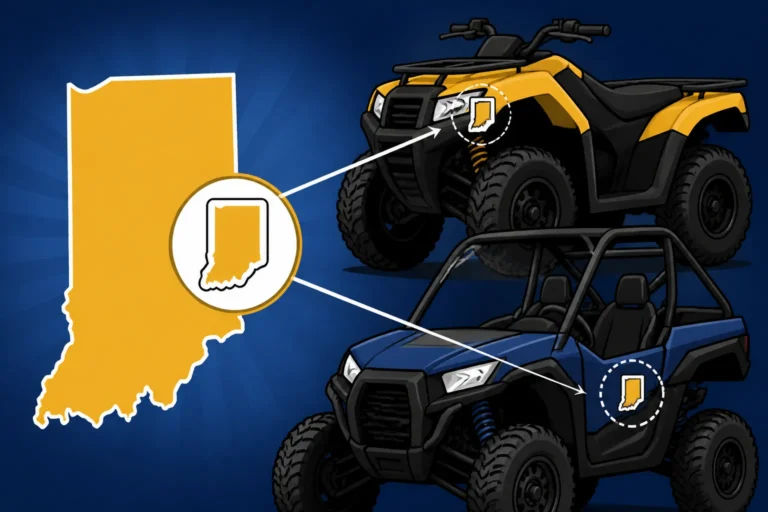
Once successfully registered, each of your ORVs will be issued a distinctive [Indiana ORV Decal Explained]. This decal is crucial; it's the visible proof of registration and must be affixed to the machine in a specific location. Indiana law specifies that the decal must be prominently displayed on the "forward half" of the machine, typically on the front fender or frame, in a clearly visible spot. [Where the Indiana Decal Mounts] is a detail you shouldn't overlook, as an improperly placed decal can still lead to questions from law enforcement.
The registration, and thus the decal, is valid for a three-year period. This means you'll need to keep track of renewal dates for each machine in your fleet. A good system for tracking these dates is vital to avoid operating unregistered machines. Planning for [How Long an Indiana ORV Registration Lasts] and its eventual renewal should be integrated into your lodge's operational calendar. If a decal ever becomes lost or damaged, you'll need to apply for a replacement, which also incurs a small fee.
| Document/Item | Purpose | Required for Each Machine | Where to Obtain/Submit |
|---|---|---|---|
| Proof of Ownership | Manufacturer's Certificate of Origin (MCO) or Title | Yes | Seller / BMV |
| Bill of Sale | Proof of purchase from previous owner | Yes (for used machines) | Seller / Lodge Records |
| Ownership Affidavit | To establish ownership if no title/MCO | Only if applicable | BMV / LawDepot (template) |
| Business Documents | FEIN, Business Name, Address verification | Yes | Lodge Records |
| Application Form | Official request for registration/title | Yes | BMV |
| Registration Fee | Payment for 3-year registration | Yes | BMV |
| Title Fee | Payment for permanent title | Yes | BMV |
| ORV Decal | Visible proof of registration | Yes | BMV (issued) |
| Registration Certificate | Paper proof of registration | Yes | BMV (issued) |
Specific Considerations for Lodge-Owned ORV Fleets
Running a lodge involves managing multiple assets and anticipating various scenarios. When it comes to your ORV fleet, there are unique legal and practical considerations that go beyond just getting a decal. These include ensuring proper titling, understanding liability when guests are involved, and efficiently managing renewals for numerous machines.
Titling Requirements for Lodge ORVs
Titling is often conflated with registration, but in Indiana, they are distinct processes, though often completed concurrently. For a lodge, proper titling is absolutely critical, as these machines are significant business assets. Indiana law mandates that most ORVs purchased after December 31, 2009, must be titled. This means if your lodge bought any ORVs after that date, they need a title in the lodge's name. [Why Indiana Titles Machines Bought After 2009] essentially brought ORVs in line with other motorized vehicles for better ownership tracking and fraud prevention.
The titling process needs to happen within a specific timeframe after purchase. Indiana imposes a [Indiana's Forty-Five Day Titling Deadline] from the date of purchase. Missing this deadline can result in an [Indiana's Administrative Penalty After 45 Days], adding an unnecessary expense to your lodge's operations. This penalty is often a flat fee, regardless of the machine's value, and it can stack up quickly if you have multiple machines. For new machines, the dealer typically handles the initial titling. However, for used machines, especially those bought privately, your lodge is responsible for initiating the title transfer.
Sometimes, a lodge might acquire older machines or those from a seller who never properly titled them. This creates a hurdle. In such cases, you might have to go through a more involved process to establish a clear title, potentially involving an ownership affidavit or even a bond if the chain of ownership is severely broken. This is where using reliable templates for legal documents, perhaps from a service like LawDepot, can help ensure you're providing all the necessary information to the BMV to eventually secure a title for your valuable business assets.
Liability, Insurance, and Operation Rules for Lodges
Operating an ORV fleet for a business, especially one that involves guests, significantly amplifies liability concerns. It’s not just about compliance; it's about protecting your lodge from potential legal issues. Standard personal ORV insurance policies are often insufficient for commercial operations. Your lodge will need a robust commercial general liability policy that specifically covers the rental and operation of ORVs by guests, as well as by staff. Discuss this in detail with your commercial insurance agent to ensure adequate coverage for property damage, personal injury, and any incidents that may occur on or off your property. [Indiana ORV Insurance Requirement] outlines the basics, but commercial operations demand much more.
Beyond insurance, your lodge needs to be acutely aware of operational rules, particularly concerning public access. Even if your ORVs primarily operate on your own land, if guests are using them, it's prudent to ensure they understand safety rules, age restrictions, and helmet requirements. For example, [Indiana Helmet Law for ORV Riders] applies to all riders under 18, regardless of where they are riding. If a guest under 18 is riding one of your lodge's machines, they must wear a helmet. Furthermore, [Indiana Rules for a Rider Under 14] and [Indiana Supervision Rules for Minors] dictate that riders under 14 must be supervised by someone at least 18 years old. These rules are especially critical if your lodge offers guided tours or rental programs.
Finally, consider where your ORVs are being ridden. If your lodge's property connects to or allows access to public roads or designated ORV trails, all state and local rules apply. [Are ATVs Street Legal in Indiana?] provides a crucial answer: generally no, but specific counties may open some roads. If your machines are used on these public access points, your operators (staff or guests) must comply with all traffic laws, speed limits, and any specific county ordinances. This includes rules regarding passengers, lighting after dark, and yielding to other traffic, as outlined in guides like [Indiana Rules for Riding a County Road].
Managing Your Lodge's ORV Fleet Registration
With multiple ORVs, managing registrations and titling becomes an ongoing administrative task. It's not a one-and-done deal. The initial registration is just the beginning. Since Indiana ORV registrations last for three years, your lodge will need a robust system to track the renewal dates for each machine in your fleet. Missing a renewal can result in fines and the inability to legally operate the machine, potentially disrupting guest services or maintenance operations. [Renewing an Indiana ORV Registration] should be a regular part of your lodge's administrative checklist.
Assigning a dedicated individual or team to oversee ORV compliance is a smart move. This person would be responsible for maintaining meticulous records for each machine, including its VIN, purchase date, title number, registration date, and renewal deadline. They would also be the point person for any issues, such as a lost or damaged decal. If a decal gets peeled off by mud or wear and tear, knowing how to quickly get a [Replacing a Lost Indiana ORV Decal] ensures continuous compliance.
Beyond official state documentation, your lodge should also maintain internal records like maintenance logs, rental agreements (if applicable), and safety inspection reports for each ORV. These documents are not only good business practice but also provide crucial evidence in case of an accident or liability claim. Again, legal document resources like LawDepot can be helpful for establishing standardized templates for these internal records, ensuring consistency and professionalism in your fleet management. Proactive management of your ORV fleet's documentation will ultimately save your lodge time, money, and potential legal headaches down the road.
Disclaimer
This article is for general informational purposes only and does not constitute professional advice. Laws, prices and regulations vary by location and change over time. Consult a qualified professional for guidance on your specific situation.