Indiana Rules for Riding a Closed Trail
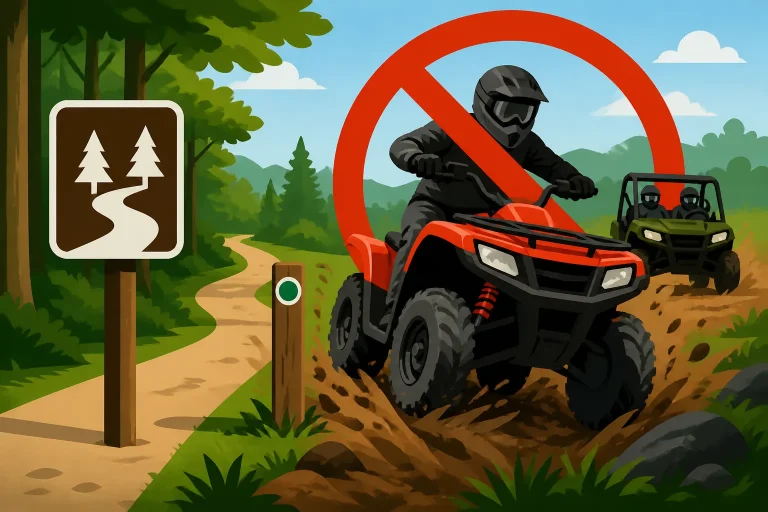
Indiana’s trail map can show a route that looks rideable, and a gate may even be open, while a posted notice says the trail is closed. A permit or registration does not cancel that restriction. Here’s how to recognize a closure, what to do when signs and maps disagree, and how to avoid turning a routine ride into a trespass or enforcement problem.
What Indiana Means by a Closed Trail
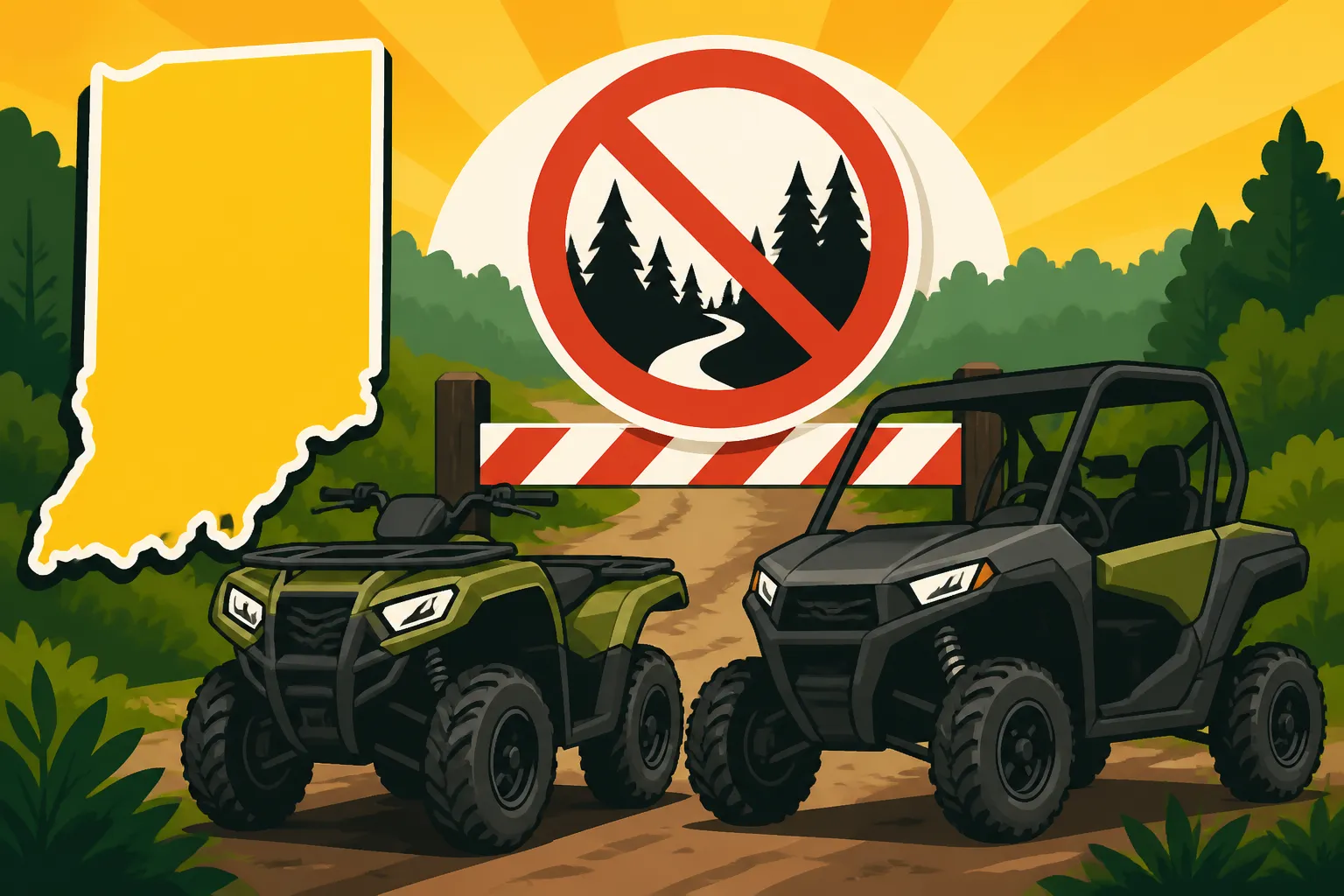
A closed trail is a route the land manager or property owner has not authorized riders to use at that time. The closure may apply to one segment, a whole riding area, or a specific type of vehicle. It may be temporary or indefinite. A trail can look usable and still be closed.
The most important distinction is between permission to ride in an area and permission to use a particular trail. A permit, registration, entrance pass, or admission to a riding area generally does not give permission to ride every route inside it. Rules may limit riders to designated, open trails, and a closure can remove a route from that permitted network.
This applies even if:
- The trail appears on an older map.
- Other riders have gone past a barrier.
- The trail is physically passable.
- Your machine is registered and you have the required permit.
- You are only trying to reach an open route, campsite, or exit.
- You have ridden that trail before.
In short, a legal document for the machine or riding area is not a substitute for current permission to use the trail. For broader context, see Indiana’s Daily and Annual Trail Permits and [Indiana Rules for Riding Off the Trail].
Closures can have different scopes
A notice might close a short section because of a washout, or it might close a larger area while maintenance is underway. Some restrictions can be seasonal or tied to weather. Others may remain in place until the land manager determines that a route is safe and available again.
The scope matters. A sign at a junction may apply only to the branch beyond that point, while a notice at an entrance may apply to the entire property or trail system. Read the full notice rather than assuming that a closure is broader—or narrower—than the wording indicates.
A closure can also apply to one vehicle category but not another. A route intended for hiking, bicycles, or another use is not automatically open to ATVs or UTVs. If the notice does not clearly identify whether your machine is allowed, do not infer permission from the route’s appearance or from seeing another kind of user there.
| What you encounter | What it means for your ride |
|---|---|
| A sign clearly marking a trail closed | Do not enter or continue onto that trail |
| A barricade, cable, or gate across the route | Treat it as a closure unless staff clearly direct otherwise |
| An official notice closing an area or trail system | Follow the stated boundary and dates or conditions |
| A map showing a route as open, but a newer sign closes it | Follow the on-site closure and confirm with staff |
| A route with no sign, but its status is uncertain | Stop and check an official notice or ask the land manager |
| An open trail leading toward a closed segment | Turn around before entering the closed section |
Who Can Close a Trail and Why
The person or agency responsible for the land generally determines which routes are available to riders. The authority depends on where the trail is: a state-managed riding area, private off-road park, club trail, or other property may each have different rules and ways to communicate closures.
A trail permit does not give a rider authority to ignore the land manager’s restrictions. Likewise, a machine’s registration does not make an otherwise closed route legal to ride. Permit and registration requirements are separate from the decision about which specific trails are open.
Common reasons for a closure
Land managers may close trails for safety, maintenance, environmental protection, or operational needs. Common reasons include:
- Unsafe trail conditions. A washout, fallen tree, unstable slope, damaged bridge, deep water, or other hazard may make a route unsafe.
- Wet or damaged ground. Riding on saturated soil can deepen ruts and damage the trail surface. A closure may help prevent further damage while conditions recover.
- Repair work. Workers may need an area clear while they repair drainage, rebuild a crossing, or move equipment.
- Resource protection. A closure may protect wildlife, vegetation, waterways, or land being restored.
- Seasonal restrictions. Access may change during certain seasons or conditions.
- An incident or emergency. Staff may close a route while responding to an accident, fire, or other urgent situation.
- Property-owner decisions. A private operator may temporarily close part of its property or change which trails are available.
You may not be able to tell the reason from the trail itself. A route can look dry and stable while still being closed for repair, habitat protection, or another purpose. The fact that you believe the reason no longer applies does not authorize you to reopen it yourself.
A closure is not the same as a trail being difficult
A challenging route is not automatically closed. A posted closure is different: it means the route is off limits under the property’s rules, whether or not you think your machine can get through. Conversely, the absence of a visible obstacle does not prove a trail is open.
Do not treat a closure as an invitation to assess the risk for yourself. If the land manager has restricted access, riders should follow that restriction and choose an open route.
How to Check Whether a Trail Is Open
Check trail status before loading your machine, then check again when you arrive. Conditions and operating decisions can change between planning and riding. A map or online post that was accurate earlier may not reflect a later closure.
Use information from the organization responsible for the property. For an official riding area, that may include posted notices, the official trail map, a park office, or staff at the entrance. For a private park or club trail, use the property operator’s current instructions. A rider’s social media post or an old map can be useful as a clue, but it should not be your final confirmation.
A practical pre-ride check
- Identify who manages the land. Confirm whether the route is part of a state area, private park, club system, or another property. The rules for one property do not automatically apply to another.
- Check current notices before leaving. Look for trail closure announcements, seasonal restrictions, weather-related updates, and changes to access.
- Read the map carefully. Check the map’s date or edition if available, the legend, and any symbols that distinguish closed, restricted, or open routes.
- Read signs at the entrance and at junctions. Pay attention to the boundary or trail segment named in the notice. Do not assume a sign is outdated because it conflicts with a map.
- Ask staff when the information is unclear. Give them the name or number of the trail and explain what you see. Ask which route is open to your specific vehicle type.
- Recheck during the ride. Watch for new signs, barriers, and staff instructions. A route may be closed after you enter the riding area.
- Choose a different route if you cannot confirm access. Uncertainty is not permission.
For a focused checklist on current notices, see Checking an Indiana Trail Notice First. When you reach an entrance or staging area, Reading the Gate Board Before You Unload can help you catch changes before you start riding. For wider planning, Indiana Trail Closures to Check is also relevant.
When signs and maps disagree
If a current sign at the trail contradicts a map that shows the route as open, do not ride past the sign. Treat the route as closed until staff or the land manager confirms otherwise. A map may not yet reflect a new closure, while a posted notice may describe a change that took effect after the map was produced.
The same caution applies when an online trail tracker, GPS device, or downloaded map shows the route. Those tools can display a route line without showing whether it is currently open to ATVs or UTVs. A mapped line is not proof of legal access.
If you can contact staff safely, ask about the specific point where the information conflicts. If you cannot get an answer, take the open route or end the ride rather than testing the closure.
What to Do When You Reach a Closed Trail
Stop before entering the closed section. Do not move a barrier, drive around it, or continue on the assumption that you can turn around later. If you are already on the route when you see a closure, do not travel farther into the restricted area. Follow the sign’s directions, turn back if it is safe to do so, and contact staff if the appropriate exit is unclear.
Turn around without creating another problem
Use a safe, authorized place to turn around. Avoid riding off the marked trail to make a new turning space, bypass a barrier, or avoid a difficult maneuver. Going around a closure can create additional problems, including damage to land outside the designated route or entry onto property where you have no permission.
If the trail is too narrow or hazardous to turn around safely, stop and seek help from park staff or the land manager. Do not assume a nearby field, service road, or connecting track is open to riders. Ask before using an alternative.
Do not remove or cross a barrier
A gate, cable, fence, or barricade may protect people, workers, land, or equipment. Do not move it, climb around it, or drive through a gap simply because your machine fits. Do not follow another rider through the barrier. A barrier is a clear reason to pause and verify access, even if the trail beyond it looks inviting.
If you believe the barrier has been left in error, contact the operator. The person responsible for the property—not the rider—decides whether the route should be opened.
Stay on the designated route
Riding around a closure can amount to leaving the authorized trail system. Do not create a shortcut through brush, cross a field, or use a drainage ditch to get around a closed segment. Permission to ride one section does not automatically extend to adjacent land.
Rules can differ by property, so do not assume that a route is allowed merely because it is wide, maintained, or used by other vehicles. For private property, get permission from the landowner or operator rather than relying on a nearby public trail map. See [Indiana Rules for Riding a Private Park] and [Indiana Rules for Riding a Club Trail] for related access questions.
Consequences and Better Alternatives
Riding a closed trail may violate the land manager’s rules and can lead to enforcement action. The specific result depends on the property, the circumstances, and the applicable rules. Possible outcomes include being directed to leave, losing access to the riding area, or receiving a citation or other penalty where the rules allow it. Damage to the trail or land can also make the situation more serious.
Do not assume that a valid permit, registration, or payment protects you from consequences for riding a closed route. Those documents do not override a closure. For more about possible enforcement consequences, see [Indiana Fines for Riding a Closed Trail].
If you accidentally enter a closed section
An accidental mistake is different from deliberately bypassing a barrier, but it is still important to respond carefully. Stop as soon as you see the notice, avoid going farther, and follow the instructions on the sign. If there is no safe way to turn around, contact staff and explain where you are. Do not conceal the mistake by taking an unauthorized route back.
Keep your communication factual and calm. If staff ask you to leave or use a particular route, follow their direction. Continuing after you have been told a trail is closed can make an avoidable mistake look like a deliberate decision to ignore the rules.
Choose an open alternative
A closure does not necessarily mean the entire ride must end. Check the current map and ask staff whether another trail or section remains open to your vehicle. Confirm the route before setting off, especially if your machine’s width or type may affect which trails are available.
If no suitable open route remains, consider ending the ride or moving to a different property with confirmed access. Before travelling to another location, check its rules and current notices rather than assuming that a neighboring park or trail system follows the same schedule.
Do not try to make the closed route part of your return plan. If a closure blocks the way you expected to exit, stop at the boundary and ask staff for an authorized way back. A detour should be confirmed, not improvised across land or trails you have not been authorized to use.
Keep the trip flexible
Closures are easier to handle when your ride plan includes alternatives. Before setting out:
- Save or carry a current official map.
- Identify open routes that suit your machine.
- Leave enough time to take a permitted detour.
- Check the property’s current notices again at arrival.
- Make sure everyone in the group understands that a closure applies to the group, even if one rider is tempted to continue.
- Agree in advance that no one will remove barriers or leave the trail to bypass a closure.
A group should stop together when someone spots a closure. Do not split up and assume the riders ahead can determine whether the trail is open. One person checking with staff is safer than several machines advancing toward a restricted area.
The central rule is straightforward: ride only on routes the responsible land manager currently allows. A trail’s appearance, a map line, another rider’s decision, or a valid permit cannot replace that permission.
Frequently Asked Questions
Does an Indiana ORV permit let me ride a closed trail?
No. A permit or registration does not override a closure. Follow the property’s current signs and instructions and use only routes open to your machine.
What if a map shows the trail as open but a sign says it is closed?
Do not enter. Treat the on-site closure as controlling until the land manager confirms that the route is open. Maps and online tools may not reflect a recent change.
Can I go around a closed trail if the detour is on private land?
Not without permission. Do not leave the designated route or cross private property to bypass a closure. Ask the landowner or operator for an authorized alternative.
What should I do if I notice the closure after entering the trail?
Stop, do not continue farther into the closed section, and follow the posted directions. Turn back only if it is safe and authorized; contact staff if you need help.
Disclaimer
This article is for general informational purposes only and does not constitute professional advice. Laws, prices and regulations vary by location and change over time. Consult a qualified professional for guidance on your specific situation.