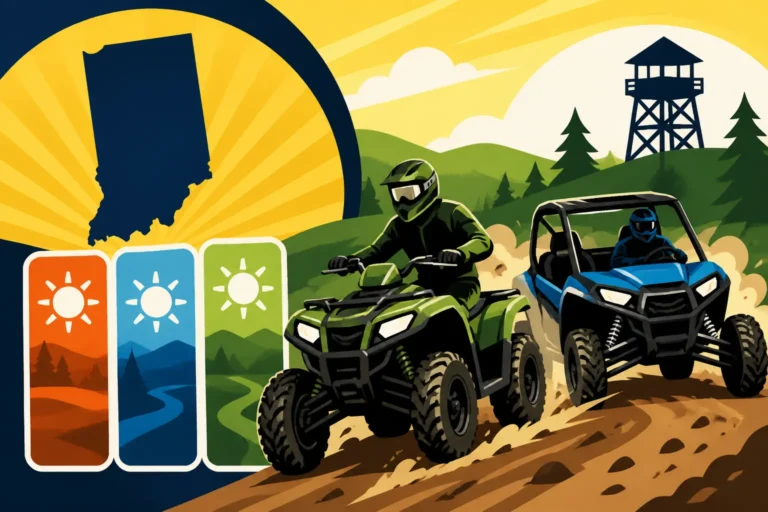
A Machine That Suits Indiana Hill Climbs
A machine that feels planted on a hill can make an Indiana ride much less stressful, but bigger and more powerful is not automatically better. Reclaimed mine terrain, changing traction, narrow routes, and steep approaches all affect what works. This guide explains how to match an ATV or UTV to Indiana hill climbs, what to check before buying, and how to ride within your limits.
What Indiana hill climbs demand from a machine
Expect changing ground, not one kind of hill
Indiana riding areas can include reclaimed mine land, wooded routes, ruts, loose material, and slick clay after rain. The terrain varies from park to park and even from one part of a trail system to another. A machine that handles a dry, firm slope may feel very different when the surface is wet, churned up, or covered in loose debris.
At Redbird in Sullivan County, riders encounter terrain shaped by the area’s mining history. Interlake, near Lynnville and spanning parts of Pike and Warrick counties, also offers varied reclaimed-land routes. Neither park should be treated as though every trail is a steep climb; conditions and route difficulty can differ. For more context, see Indiana’s Reclaimed Mine Riding, Indiana’s 1,400-Acre Redbird, and Interlake at Lynnville.
That variation matters when choosing a machine. Traction, predictable throttle response, ground clearance, and manageable weight often matter more than a high top speed. If a hill’s surface is loose, spinning the tires can quickly make a manageable climb harder. If the trail is narrow or uneven, a machine that feels oversized may be difficult to position safely.
Traction and control beat raw power
A powerful engine can help a machine climb, but it cannot create grip where there is none. Tires, tire condition, pressure, surface, and rider input all affect traction. A machine that delivers power smoothly can be easier to manage than one that reacts abruptly when you touch the throttle.
Four-wheel drive can be useful on challenging terrain, but it is not a guarantee against sliding, tipping, or getting stuck. It also does not make every slope appropriate for every rider. Before attempting a climb, consider whether you can see the route, whether the surface looks loose or rutted, and whether there is room to stop or turn around safely.
A useful starting point is to think about the trails you actually plan to ride. If your usual outings are moderate loops with occasional climbs, a balanced recreational machine may suit you better than a specialized, heavily modified build. If you regularly ride more demanding routes, compare machines with attention to traction, low-speed control, stability, and serviceability—not just advertised horsepower.
ATV or UTV for Indiana hills
When an ATV may be the better fit
An ATV is often easier to place on a narrow trail than a wider side-by-side. Its compact footprint can be useful where a route bends tightly or has limited room around obstacles. It may also feel more direct to an experienced rider who wants to shift body position while navigating uneven ground.
That compact size does not make an ATV automatically safer on steep terrain. Balance, speed, line choice, and rider experience still matter. A steep or off-camber section can challenge an ATV, especially if the rider approaches too fast or tries to turn sharply on a slope. Choose a machine that fits your size and strength, and spend time learning its controls on easier ground before taking on harder routes.
An ATV can be a sensible option if you ride alone or with a small group, prefer narrower trails, and are comfortable handling the machine yourself. If you are still comparing models, Best First ORV for Indiana Trails and Best Machine Width for Indiana Parks can help frame the trade-offs.
When a UTV may make more sense
A UTV can be a better match when you want side-by-side seating, a steering wheel, or room for a passenger and gear. Some riders also prefer having a seat and restraint system, particularly on longer outings. Those features can improve comfort, but they do not remove the need to choose suitable trails and drive cautiously.
Width and weight deserve extra attention. A larger machine may not fit every route as comfortably as a narrower ATV, and its weight can affect how it responds on soft or uneven ground. Check the park’s machine rules and route information before heading out; a vehicle that is suitable for one trail system may not be a good fit for another. Indiana Trails for a Wide Machine is a useful companion when comparing trail access.
For a UTV, also consider the passenger. A passenger changes how the machine is loaded and can affect handling, especially on slopes or uneven ground. Make sure everyone understands the restraint system, stays seated as instructed, and follows the vehicle’s requirements. A roll cage is not a substitute for careful driving or a reason to attempt a slope that exceeds your ability.
| Consideration | ATV may suit you if | UTV may suit you if |
|---|---|---|
| Trail width | You expect narrower routes and want a compact machine | You have checked that the routes can accommodate the vehicle |
| Riding position | You prefer an open, hands-on riding experience | You want seated side-by-side driving |
| Passengers | You usually ride solo or with separate machines | You want to carry a passenger in a designated seat |
| Hill control | You can manage balance and body position confidently | You can manage the vehicle’s size, weight, and passenger load |
| Storage and transport | You want a smaller footprint for hauling or storage | You have suitable trailer space and storage |
The table is only a starting point. The exact model, condition, tires, suspension, rider skill, and trail conditions all influence how a machine behaves.
Features to compare before you buy
Weight, wheelbase, and ground clearance
A machine’s weight affects more than hauling. On loose or soft ground, a heavier vehicle may sink or struggle where a lighter one rolls through more easily. Weight can also make a stuck machine harder to recover. On the other hand, a very light machine with inadequate tires or power may not be the right match for a rider’s planned terrain. Look at the complete package rather than treating weight as a single pass-or-fail number.
Wheelbase and overall dimensions influence how a machine behaves on uneven approaches and tight turns. There is no universal ideal: a longer machine may feel stable in some situations but be less nimble in confined spaces. Compare measurements across models, then consider where you ride. At a dealership, sit on the machine and check whether the controls feel natural; if possible, test the turning position and mounting height.
Ground clearance can help with ruts, rocks, and uneven surfaces, but more clearance is not a guarantee that the underside will never contact the trail. Avoid choosing a machine solely because it looks tall or aggressive. For riding in reclaimed clay and uneven terrain, Tires for Reclaimed Mine Clay and Tire Pressure for Reclaimed Clay offer useful points to consider alongside the machine itself.
Tires, gearing, and recovery equipment
Tire tread affects how a machine grips, but aggressive tread is not automatically best for every surface. Tires that work well in mud may behave differently on firmer ground, and a tire that spins easily can dig a deeper hole when traction disappears. Think about your most common conditions rather than buying for the muddiest day you might ride all season.
Gearing and throttle response matter during slow, controlled movement. A machine that is easy to modulate can help a rider maintain a steady pace rather than lurching forward. Ask about available drive modes and how the machine behaves at low speed. If you are new to hills, gentle and predictable response is generally more useful than a setup that encourages fast approaches.
A winch can be valuable recovery equipment, but it is not a license to attempt a risky climb. Learn how to use it, carry suitable recovery gear, and follow safe recovery practices. A winch also depends on having an appropriate anchor and a clear plan. See Choosing a Winch for a Reclaimed Mine Bench for more on matching recovery equipment to the kind of riding you do.
Plan the route and ride the hill cautiously
Check the trail before unloading
Before a trip to Redbird, Interlake, or a private riding area such as Haspin Acres near Laurel, check the location’s current trail information and rules. Park access, route conditions, and permitted machine types can vary. Recent rain can change traction and ruts, while a trail that seems straightforward on a map may feel different when you reach it.
A mapping tool such as onX Offroad can help you review your planned area and keep track of where you are, but use it as a planning aid—not as permission to ride anywhere shown on a screen. Confirm that a route is open and designated for your machine, and follow posted signs and staff directions. Park information and trail maps are also worth checking before you leave home; Indiana Trail Maps From the DNR and Indiana Trail Conditions Before You Ride are relevant starting points.
It helps to plan a route with options. If a climb looks more difficult than expected, turn around before reaching the steepest section rather than feeling pressured to continue because other riders are waiting. If you ride with a group, agree on a meeting point and a signal for stopping. Keep enough space between machines so the rider ahead can make decisions without being crowded.
Approach climbs with an exit plan
Before climbing, stop in a safe place and assess the route. Look for loose material, deep ruts, water, overhanging branches, and a clear path to the top. If you cannot see where the trail goes, do not assume the unseen section is safe. A less experienced rider should watch from a safe location while an experienced member of the group assesses the route, rather than following blindly.
Use a controlled pace and avoid abrupt steering or throttle inputs. Do not attempt a steep climb at speed to “carry momentum,” especially if you cannot see the surface or the route is busy. If the machine begins to lose traction or the climb feels beyond your ability, prioritize a safe stop and follow your training and the vehicle manufacturer’s guidance. Avoid turning across a steep slope unless you know how to do so safely; a sudden sideways movement can make a machine unstable.
Your choice of machine should make appropriate riding easier, not tempt you into harder routes. A capable ATV or UTV still has limits, and rider judgment is part of the setup. Start with easier trails, learn how your machine reacts under gradual changes in slope, and build confidence without treating a challenging hill as a test you have to pass. onX Offroad may help you plan where to ride, but a map cannot tell you whether today’s surface, your machine, and your skill level are a safe match.
Disclaimer
This article is for general informational purposes only and does not constitute professional advice. Laws, prices and regulations vary by location and change over time. Consult a qualified professional for guidance on your specific situation.