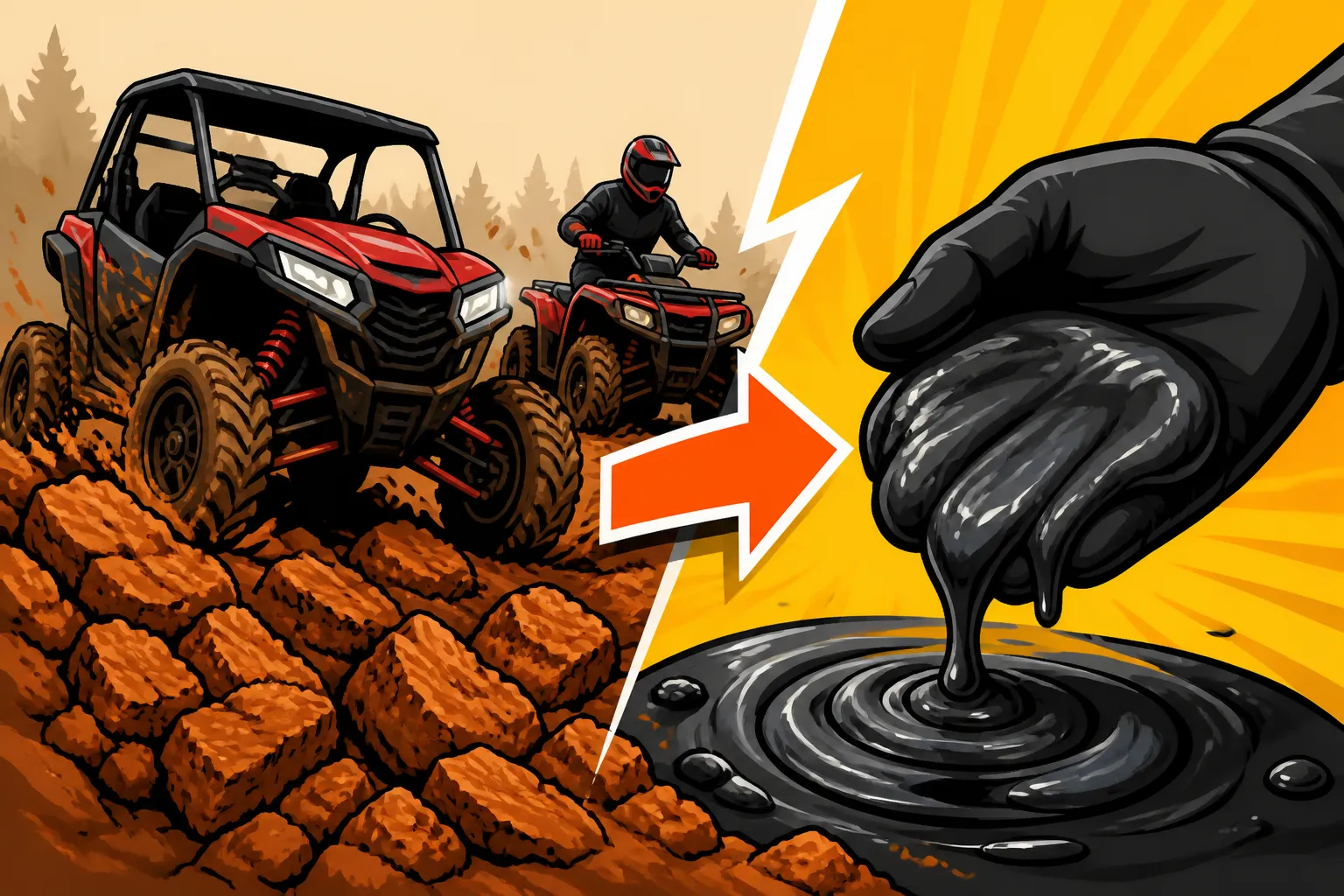
Reclaimed Clay That Turns to Grease
Reclaimed clay can feel firm and predictable when dry, then turn slick and gluey after a little rain. That change catches Indiana ATV and UTV riders off guard: tires lose their bite, ruts deepen, and a short route can become a recovery job. Here’s how to read the conditions, decide whether to ride, and reduce the mess and risk.
Why reclaimed clay turns slippery
How wet clay changes under your tires
Many Indiana riding areas include ground shaped by former mining. At places such as Redbird Off-Road State Recreation Area near Dugger and Interlake Off-Road State Recreation Area near Lynnville, trails may cross old haul roads, spoil piles, and exposed earth. The soil varies across a park, but fine-grained clay can be especially tricky when it gets wet.
Dry clay may feel solid because its particles are packed together. Add water, and the surface can become slick as the particles move against one another. Instead of digging into a firm trail, tire lugs may smear the wet layer across the ground. The result is often a greasy surface that looks manageable but offers much less traction than expected.
That grip can change quickly from one section to the next. A gravelly stretch may still feel stable while a shaded clay dip just beyond it is slick. A rider may make it through the first muddy patch and assume the rest of the loop is similar, only to encounter a steeper, softer slope that demands a very different approach.
Why a small amount of rain can matter
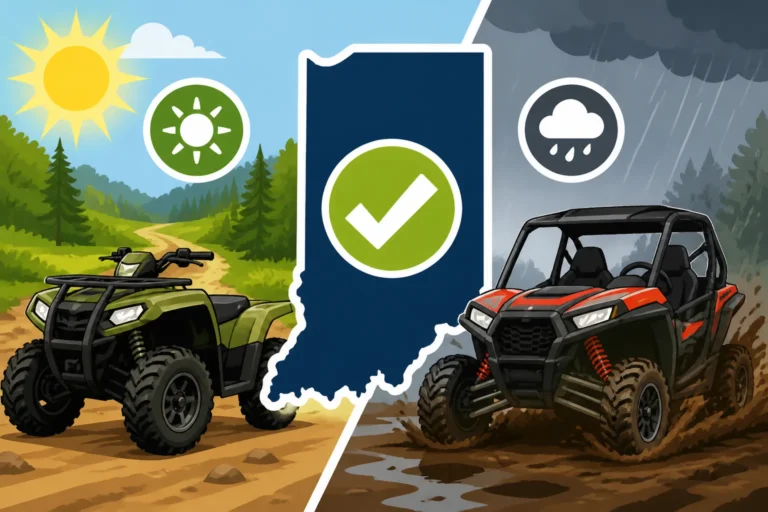
The amount of rain alone does not tell the whole story. Soil type, drainage, shade, slope, and how many machines have recently used a route all affect how it rides. A brief shower might leave a well-drained trail mostly firm, while the same shower can soften a low section that already holds water.
Repeated tire traffic can make conditions worse. On a wet slope, spinning tires loosen the surface and push soil downhill. The first few machines may leave shallow marks; later riders can find deeper ruts and less room to pick a clean line. That’s one reason a route that felt fine earlier in the day may be more difficult by afternoon.
Clay also tends to cling to tires and machine parts. As buildup grows, it can fill tread grooves, add weight, and reduce the tire’s ability to clear itself. If your machine starts to feel heavier or the tread looks packed smooth, don’t assume more throttle will solve the problem. On greasy ground, spinning faster can polish the surface and deepen the rut.
What the trail is telling you
Look beyond the puddles. A shallow pool may sit over a firm base, while a damp-looking patch can hide a slippery layer. Pay attention to the trail’s shape, recent tire marks, exposed roots, and how the ground responds to a cautious walk or a gentle test with a boot at a safe stopping point.
Watch for signs that traction is deteriorating: tires sliding sideways, steering that feels vague, repeated wheelspin, or a machine sinking farther with each attempt. Those are cues to slow down, choose a safer route, or turn around—not invitations to keep pushing until recovery becomes necessary.
For a deeper look at how rainfall affects Indiana riding areas, see Indiana Riding After Heavy Rain. If a wet weekend has already changed the surface at Redbird, Ruts Left by a Wet Weekend at Redbird explains why trails can become harder to ride even after the heaviest rain has passed.
Decide whether the ride is worth it
Check conditions before leaving home
A weather forecast is useful, but it cannot tell you exactly how a particular trail will feel. Check the park’s own notices for closures or condition updates before loading your machine. If you’re heading to a specific riding area, a quick call to the park office can help clarify whether the trails you plan to use are open and what riders should expect.
It’s also worth checking conditions close to your departure time. Rain can pass over one part of southern Indiana while another area stays mostly dry. A forecast for Dugger may not describe conditions around Lynnville, and yesterday’s report may not reflect overnight rain or a busy morning on the trails. Start with Indiana Trail Conditions Before You Ride and Indiana Trail Closures to Check First.
Mapping tools can help you plan a route and keep track of where you are, particularly in areas with multiple junctions or limited cell coverage. Some riders use onX Offroad to prepare a route before leaving, but a digital map should be treated as a planning aid, not as confirmation that a trail is open or passable. Follow posted signs and park directions, and don’t ride a closed route just because it appears on a map.
Use a simple go-or-no-go check
A useful decision is not just “Is there mud?” It’s whether the conditions match your machine, experience, group, and willingness to turn back. A capable UTV with appropriate tires may handle ground that feels uncomfortable on a light ATV, but no setup makes a steep, greasy slope risk-free. A novice rider may also find a familiar route unexpectedly challenging when traction changes.
Before unloading, consider the recent weather, the trail’s drainage, and whether the group has a sensible way to respond if someone gets stuck. If you’re riding with children or less experienced friends, choose an easier route and agree on a turnaround point. Nobody should feel pressured to follow the fastest rider into a section they don’t feel comfortable attempting.
| What you notice | What it may mean | A sensible response |
|---|---|---|
| Firm ground with scattered damp patches | Traction may vary by section | Ride cautiously and reassess often |
| Slick tire marks on a slope | The surface may be losing grip | Avoid climbing it if a safer route is available |
| Deep, fresh ruts | Traffic and water have softened the trail | Turn around or choose a firmer route |
| Tread packed with clay | Tires may not clear well | Stop safely, inspect the tires, and avoid excessive wheelspin |
| Standing water with no clear view of the base | The ground underneath may be soft or uneven | Don’t assume the puddle is shallow; bypass it if possible |
If the group is already struggling on level ground, don’t treat a steep hill as the place to test a new technique. A short ride is better than a damaged machine or an avoidable recovery. Conditions can improve another day, and postponing is often the least frustrating choice in the long run.
Plan a flexible route
A route plan should include an easier option and a clear point where the group will reconsider. Before riding, talk through how you’ll communicate if machines become separated, where you’ll stop safely, and what you’ll do if the trail becomes too slick. Keep enough time and fuel for a return trip that takes longer than expected.
In areas with confusing junctions, a saved route can reduce the stress of finding your way back. onX Offroad may help with advance route planning, but keep an eye on trail signs and local instructions throughout the ride. Do not assume that a mapped line represents a maintained trail or that a route remains open after weather changes.
Let someone at home know where you expect to ride and when you plan to return. That small step matters more when conditions are poor, service is unreliable, or the group is riding in a remote part of southern Indiana.
Ride with more control on greasy clay
Choose lines carefully and avoid unnecessary wheelspin
On wet clay, smooth inputs matter. Sudden acceleration can make the tires spin without moving the machine forward, while abrupt braking or sharp steering can cause a slide. Keep your speed modest, leave extra room between machines, and make changes gradually. If you feel the tires begin to slip, ease off rather than adding more throttle immediately.
Look for the most stable path you can use without damaging the trail or leaving the designated route. That might mean avoiding the deepest rut or a polished incline, but it does not mean cutting across vegetation or making a new trail around a muddy spot. Stay within marked riding areas and follow the park’s rules. A bypass that seems harmless can widen quickly when every rider takes it.
If you meet another machine on a narrow section, stop where you have a stable position and communicate before either vehicle moves. On a slippery grade, rushing past another rider can create a collision or push one machine into a rut. Give the group time to sort out the safest order of travel.
Treat climbs, descents, and ruts differently
A greasy climb can tempt riders to build speed, but momentum is not a substitute for traction. If a hill is already showing deep ruts or fresh wheelspin, choose a different route rather than attempting it just because someone else made it up earlier. Conditions may have changed, and a machine that slides sideways on a slope can be difficult to control.
Descending takes care too. Avoid abrupt braking that could cause the tires to lose grip, and don’t follow too closely behind another machine. If the descent is steep, uneven, or beyond your comfort level, stopping in a safe place and turning around may be wiser than trying to prove the machine can handle it.
Ruts can pull a tire in a direction you did not intend, especially when the edges are soft. Keep your focus on the route ahead, rather than staring at the tire or the deepest part of the rut. If the trail has become so damaged that there is no safe line, turn back instead of widening the damage to get around it.
Set tire pressure with care
There is no single tire-pressure setting that suits every ATV or UTV, tire, load, and trail. Follow the machine and tire manufacturers’ guidance, and avoid making a large pressure change just because the ground is muddy. Too little pressure can increase the risk of tire damage or a bead problem, especially when a machine is carrying passengers or cargo.
Check the tires before the ride and again if the handling changes. When clay packs into the tread, stop in a safe place and inspect the tires rather than trying to clear them with aggressive wheelspin. For more detail on this specific issue, see Tire Pressure for Reclaimed Clay.
If the trail is soft enough that you’re relying on a setup change to make an unsafe route seem manageable, that’s a useful warning. A different trail or another day is usually a better answer than experimenting with tire pressure on a steep, slippery section.
Protect the trail and clean up afterward
Don’t turn one muddy patch into a bigger problem
It can be tempting to power through a slick patch because stopping feels inconvenient. But repeated spinning can dig holes, break down the trail edge, and leave deeper ruts for the next group. If you are losing traction, pause in a safe spot and decide whether to back out, take a permitted alternate route, or call the ride.
Avoid riding around a muddy section by cutting into grass, brush, or the side of the trail. That can damage the surrounding area and create an unofficial path that other riders may follow. Use signed routes, respect closures, and give a soft trail time to recover when the park asks riders to stay off it.
A route that is technically open may still be a poor choice for your group on a particular day. Respecting the conditions protects both your machine and the riding area—and helps keep trails usable for everyone.
Clean the machine before trailering home
Clay buildup can hide damage and add strain to parts that need to move freely. After the ride, check the wheels, fenders, suspension, skid plates, and underbody. Look for packed material near moving parts and make sure the tires are free of heavy buildup before you drive away.
Use designated wash areas where available, and follow the park’s instructions. If you’re cleaning at home, avoid washing mud into a storm drain, ditch, or waterway. A careful rinse and inspection can make it easier to spot a loose fastener, damaged boot, or new scrape before the next ride.
For a practical post-ride routine, see Washing a Machine Before You Load. If the weather turns colder and trails begin to firm up, Riding Redbird After First Frost offers a useful contrast to the warm, wet conditions that make clay especially slick.
Make the next ride easier to plan
After returning home, note which sections were firm, where the clay became greasy, and how long the ride took. These observations are more useful than a vague memory of “muddy conditions,” especially when you’re deciding whether to bring a newer rider or choose a different loop next time.
You can also save the route you actually rode and mark places where you turned around or found poor traction. A tool such as onX Offroad can help organize route notes for future planning, but keep your notes separate from official trail-status information. Check park notices again before the next trip rather than assuming your previous route will be open and unchanged.
The most important lesson is to stay willing to change the plan. Reclaimed clay can shift from firm to slick within a short distance, and a good ride depends less on forcing your way through than on noticing when the ground is asking you to slow down or head back.
Disclaimer
This article is for general informational purposes only and does not constitute professional advice. Laws, prices and regulations vary by location and change over time. Consult a qualified professional for guidance on your specific situation.